

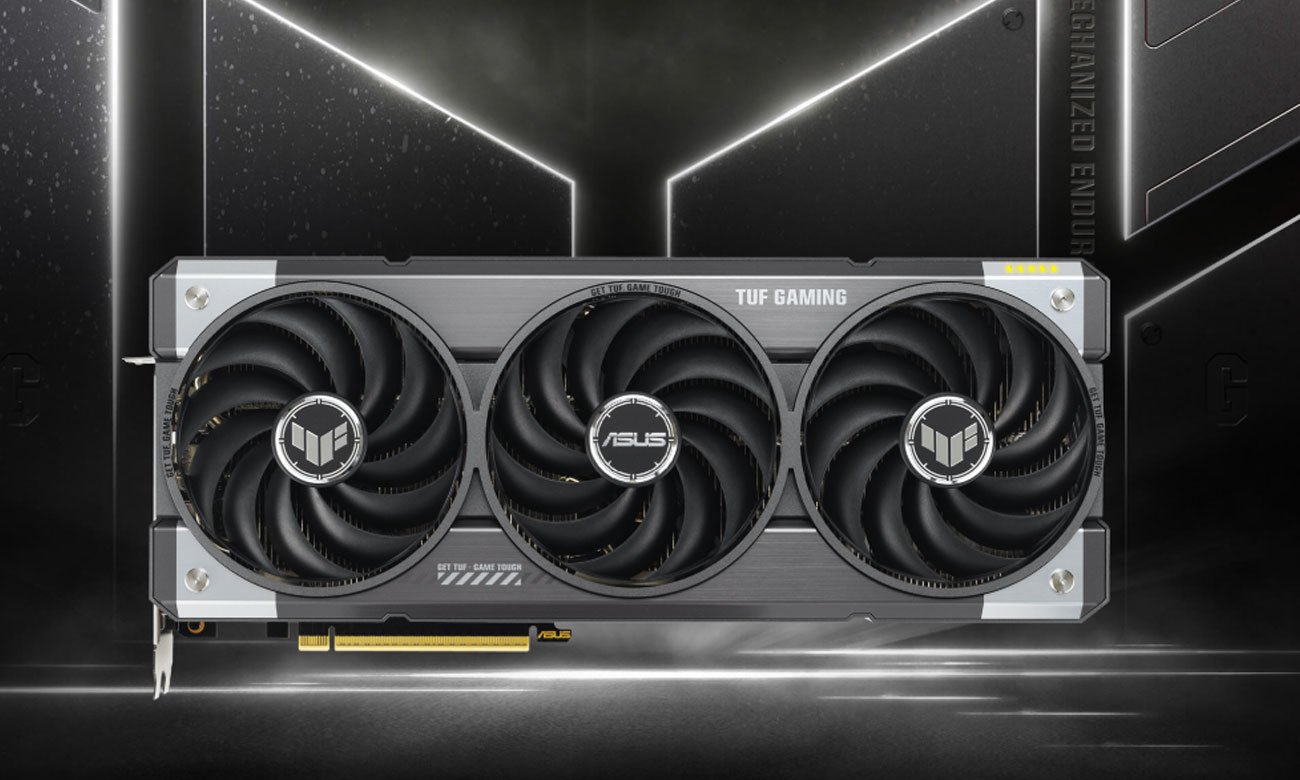
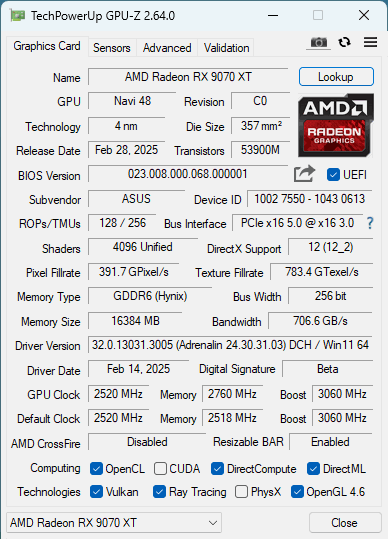
The AMD Radeon RX 9070 XT is a high-end graphics card released on March 6, 2025. Built on a cutting-edge 4 nm process and powered by the Navi 48 GPU in its Navi 48 XTX configuration, this card fully supports DirectX 12 Ultimate. This ensures compatibility with all modern games and enables advanced features such as hardware-accelerated ray tracing, variable-rate shading, and other next-gen technologies.
The Navi 48 GPU is a sizable chip, featuring a die size of 357 mm² and packing 53.9 billion transistors. It houses 4,096 shading units, 256 texture mapping units (TMUs), and 128 render output units (ROPs). The card also includes 64 ray tracing acceleration cores and 128 tensor cores designed to boost machine learning performance.
Equipped with 16 GB of GDDR6 memory on a 256-bit memory bus, the RX 9070 XT runs its GPU at a base clock of 1,660 MHz, which can boost up to 2,970 MHz. The memory operates at an effective speed of 20.1 Gbps (2,518 MHz actual clock).
As a dual-slot card, the RX 9070 XT draws power from two 8-pin connectors and has a maximum power consumption of 304 watts. For display connectivity, it offers one HDMI 2.1b port and three DisplayPort 2.1a outputs. The card interfaces with the system via PCIe 5.0 x16, providing ample bandwidth for high-end gaming and professional workloads.
At launch, the Radeon RX 9070 XT was priced at $599 USD.
| Category | Details |
| GPU | Navi 48 XTX (RDNA 4.0, 4 nm, TSMC) |
| Compute Units | 64 Compute Units, 4096 Shading Units, 256 TMU, 128 ROPs, 128 Tensor Cores, 64 RT Cores |
| Memory | 16 GB GDDR6, 256-bit, 644.6 GB/s, 20.1 Gbps effective |
| Clocks | 1660 MHz (base), 2970 MHz (boost), 2518 MHz memory clock |
| Interface | PCI Express 5.0 x16 |
| Video Outputs | 1× HDMI 2.1b, 3× DisplayPort 2.1a |
| Power / Power Connectors | 304 W TDP, 2× 8-pin connectors, recommended PSU: 700 W or higher |
| Dimensions | Dual-slot design (exact mm not specified) |
| Technologies | DirectX 12 Ultimate, Vulkan 1.4, OpenGL 4.6, OpenCL 3.0 |
| Cache | L0: 32 KB per WGP, L2: 8 MB, L3: 64 MB |
| Theoretical Performance | FP32: 48.66 TFLOPS, Pixel Rate: 380.2 GPixel/s, Texture Rate: 760.3 GTexel/s |
| Process Technology | 4 nm (TSMC N4P FinFET), 53.9 billion transistors, 357 mm² die size |
| Release Date | 03/06/25 |
| Launch Price | 599 USD |
| Compatibility | Ray Tracing, Full DirectX 12 Ultimate, (no DLSS, uses FSR instead) |
Performance Comparison
Radeon RX 9070 XT – Case and Cooling
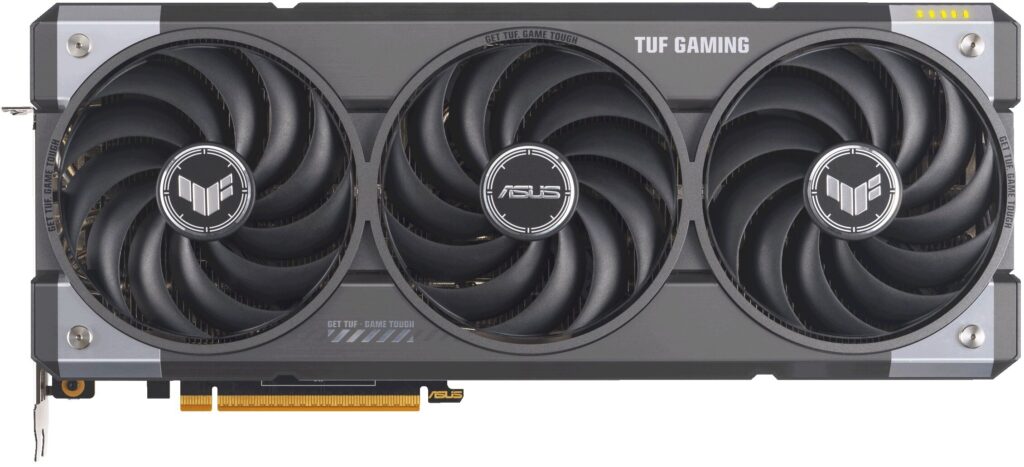
The Radeon RX 9070 XT is a high-end graphics card designed for enthusiasts seeking top-tier performance, and its physical design reflects that. The card comes in dual-slot or triple-slot configurations, depending on the model, and has a substantial size that demands careful case compatibility checks. With a length of 330 mm (13 inches), width of 140 mm (5.5 inches), and height of 63 mm (2.5 inches), it fits best in mid-tower or full-tower cases. Small form factor (SFF) or ITX cases will likely be incompatible without major compromises.
Cooling for the RX 9070 XT is engineered for extreme workloads, utilizing a robust heatsink with multiple heat pipes and a large surface area for heat dissipation. Most models feature a triple-fan system to handle the card’s 304–330 W TDP, ensuring stable operation during prolonged gaming or GPU-intensive tasks. Fan curves are optimized for quiet performance at low to moderate loads, but under heavy gaming or rendering, they ramp up significantly to maintain safe temperatures.
High-end variants also come with vapor chamber cooling for improved heat transfer from the GPU core to the aluminum fins, paired with large copper baseplates for memory and VRM cooling. This advanced thermal design keeps the GPU running at peak boost clocks without throttling, even in demanding scenarios like 4K gaming with ray tracing enabled.
Power delivery for the RX 9070 XT requires two or three 8-pin power connectors, and AMD recommends a 700 W or higher PSU for stable operation. Display connectivity includes one HDMI 2.1b port and three DisplayPort 2.1a outputs, making the card ideal for multi-monitor setups or high-refresh-rate 4K displays.
Build Quality and Materials
The ASUS TUF Gaming Radeon RX 7900 XT OC Edition is designed with durability and premium aesthetics in mind. The shroud is crafted from high-quality aluminum with a textured, matte finish that gives the card a rugged yet refined look. This design not only enhances rigidity but also contributes to efficient heat dissipation. The overall color scheme follows ASUS’s TUF Gaming identity – a dark, industrial style complemented by subtle metallic accents and customizable RGB lighting integrated into the logo.
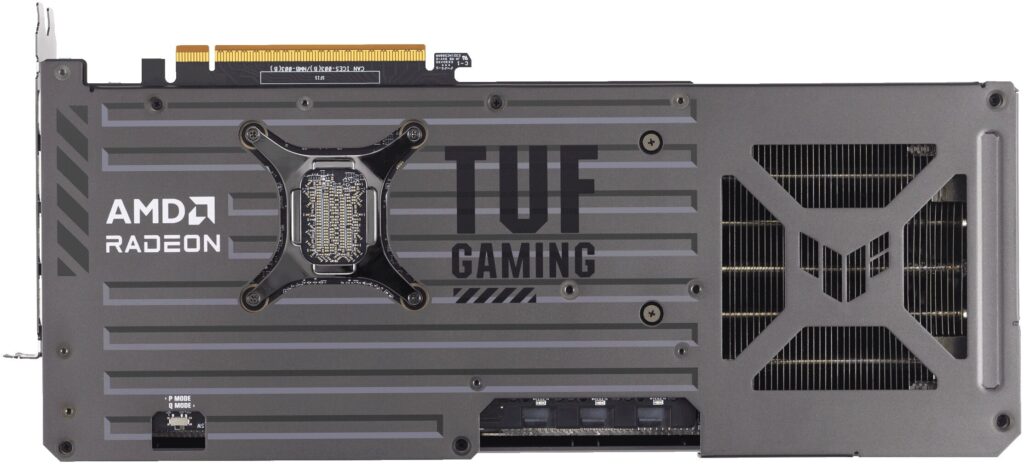
A full-length metal backplate covers the rear of the PCB, providing structural reinforcement to prevent bending and protect sensitive components. The backplate features cutouts for improved airflow and thermal management, which is particularly important given the card’s high-performance nature.
Overall, the materials and craftsmanship reflect the card’s premium positioning in the market. Every element, from the sturdy shroud to the reinforced backplate, is engineered to deliver both robustness and a professional aesthetic.
Internal Design and Performance
At its core, the ASUS TUF RX 7900 XT OC is powered by AMD’s RDNA 3 architecture, featuring the Navi 31 GPU. This architecture introduces chiplet-based design for better scalability and performance per watt compared to the previous generation. The card boasts 20 GB of GDDR6 memory on a 320-bit bus, delivering exceptional bandwidth to handle high-resolution textures and demanding workloads.
With an OC Mode boost clock of up to 2535 MHz, the TUF Gaming RX 7900 XT offers outstanding gaming performance, easily handling 4K gaming at high or ultra settings while maintaining smooth frame rates. It supports DirectX 12 Ultimate, hardware-accelerated ray tracing, and AMD-exclusive technologies such as FSR 3, Radeon Super Resolution, and Anti-Lag+, ensuring an optimized experience for gamers and creators alike.
ASUS has implemented its Axial-tech fan design with three larger fans for improved airflow, paired with a massive heatsink and vapor chamber for superior cooling efficiency. The 0 dB technology keeps the card silent under light loads, while the dual BIOS switch allows users to choose between Performance and Quiet modes depending on their needs.
Gaming / Benchmark Performance – ASUS TUF RX 7900 XT OC
Gaming and Benchmark Performance
| Game / Test | Settings | Resolution | Avg. FPS / Score |
|---|---|---|---|
| Cyberpunk 2077 | Ultra + FSR Quality | 1440p | ~96 FPS |
| Hogwarts Legacy | Ultra + FSR Quality | 1440p | ~102 FPS |
| Forza Horizon 5 | Ultra | 1440p | ~160 FPS |
| Call of Duty: MW III | Extreme / Very High | 1440p | ~175 FPS |
| F1 24 | Ultra | 1440p / 4K | ~190 FPS (1440p) / ~125 FPS (4K) |
| 3DMark Time Spy | Benchmark | – | ~27 500 – 28 800 pts |
Processor and graphics card
Design & Size – Check Your Case Before Buying
The ASUS TUF RX 9070 XT OC is a big card – around 320 mm in length with a triple-slot design, so make sure your case has enough space. It’s clearly made for mid-tower or full ATX builds, not tiny cases. The build quality is top-notch – solid backplate, reinforced frame, and that classic TUF aesthetic that screams durability.
Specs Overview – Plenty of Power for 1440p and 4K
Here’s what you’re getting:
- 16 GB GDDR6 VRAM on a 256-bit bus – great for modern games at 1440p Ultra and even solid at 4K.
- RDNA 4 Architecture (Navi 48 GPU) – more efficient, improved RT performance, and full support for FSR 4.
- Dual BIOS – performance mode or quiet mode at the flip of a switch.
- Ports: HDMI 2.1b, DisplayPort 2.1a – perfect for high-refresh monitors.
- Power: Two standard 8-pin connectors – no 12VHPWR headaches, just plug and play.
Cooling – Whisper Quiet Performance
This is where ASUS killed it. The TUF cooler uses a triple-fan design with idle fan-stop. In Quiet BIOS mode, the card is almost silent, even under heavy load. Temps stay under control without turning your PC into a jet engine. If you care about acoustics, this is one of the quietest high-end cards I’ve tested.
Performance – How Fast Is RX 9070 XT?
Let’s talk real-world gaming. At 1440p Ultra, this card is a beast – it beats the RTX 5070 in pure rasterization and even performs close to the RX 7900 XT in many titles. At 4K, you can absolutely game with high settings, though you might need to tweak a few options in the most demanding games.
Ray tracing? Big improvement over RDNA 3, but let’s be real – NVIDIA still wins with DLSS and Frame Generation. AMD’s answer is FSR 4, which is getting better, but DLSS is still ahead in terms of image quality and performance boost.
Power & Efficiency – AMD Finally Nailed It
Power draw is reasonable, and AMD fixed that annoying multi-monitor idle power bug from previous gens. This card runs cool and sips power compared to what it offers in performance.
Pros:
✔ Fantastic 1440p performance, solid at 4K
✔ Super quiet cooling system
✔ 16 GB VRAM – great for future-proofing
✔ Modern features: DP 2.1a, HDMI 2.1b, PCIe 5.0
✔ Dual BIOS, great build quality
Cons:
✖ Likely higher price than MSRP
✖ Ray tracing still behind NVIDIA with DLSS 3.5
✖ Big card – check case clearance
Score: 4.5/5
If you want high-end gaming without breaking into RTX 5090 pricing, the ASUS TUF RX 9070 XT OC is a fantastic choice. It crushes 1440p, handles 4K well, runs whisper quiet, and has all the modern features you’d want. If AMD can keep the price competitive, this card will be a no-brainer for a lot of gamers.
0 Comments