

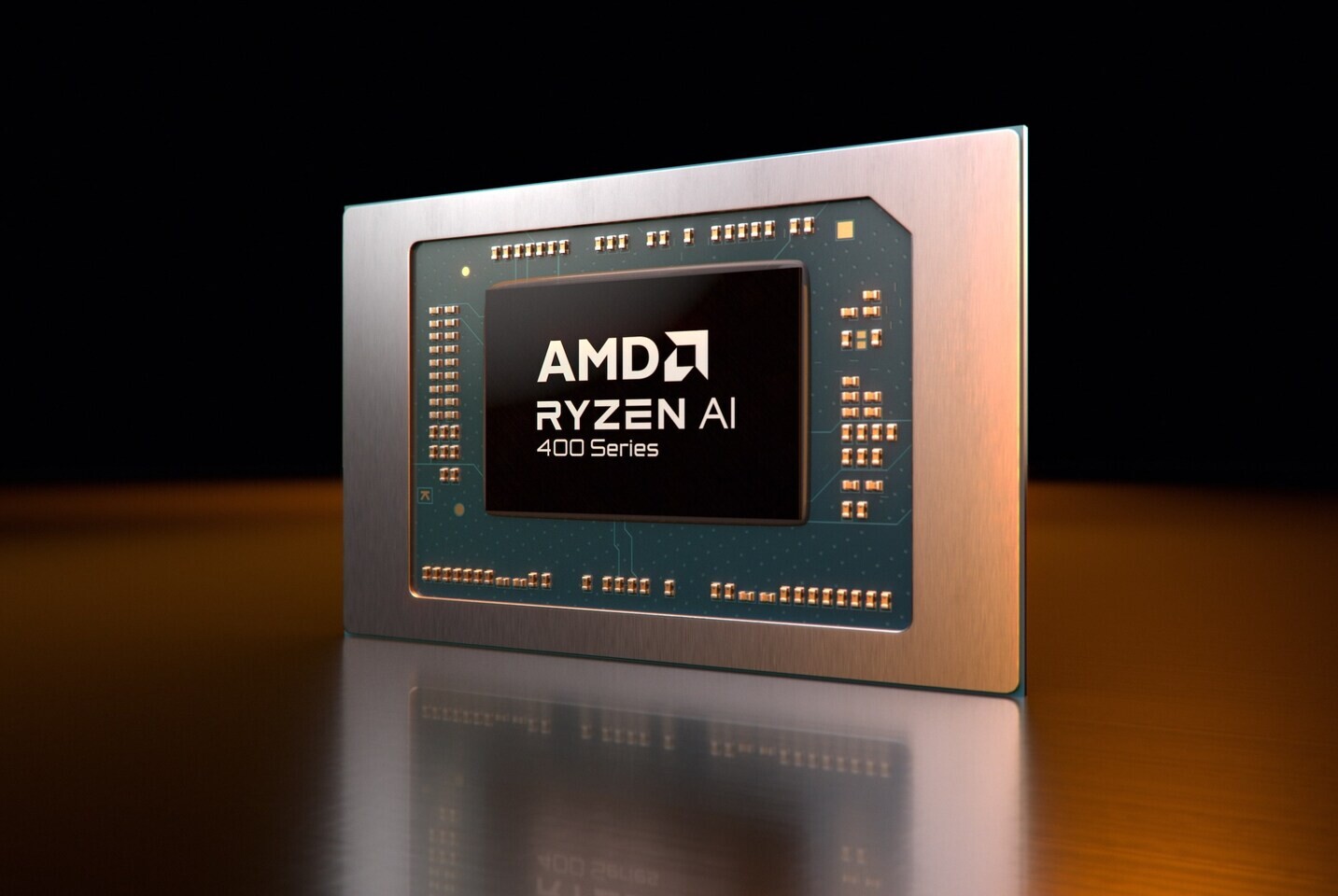
At CES 2026, AMD announced the new Ryzen AI 400 Series (code-named Gorgon Point) mobile APUs for Copilot+ Windows laptops. These are built on an improved 4nm (“N4X”) version of AMD’s Strix Point silicon, offering higher clock speeds and revamped power management for better performance and efficiency. The chips still use hybrid Zen 5 architecture (big Zen 5 and compact Zen 5c cores) with integrated RDNA 3.5 graphics and a beefed-up XDNA 2 NPU. In AMD’s words, the new lineup delivers “up to 60 TOPS” of AI compute and supports faster LPDDR5x-8533 memory – an upgrade from the 8000 MT/s limit of the prior generation.
Hybrid Zen 5 + Zen 5c Design
The Gorgon Point APUs continue AMD’s hybrid core design. The top-end Ryzen AI 9 SKUs pack up to 12 cores (24 threads) – comprising 4 full Zen 5 cores plus 8 smaller Zen 5c cores – arranged in a dual-CCX layout. Each CCX has its own shared L3 cache: the four Zen 5 cores share a 16 MB L3 slice, while the eight Zen 5c cores share an 8 MB L3 (24 MB total). (Zen 5c cores are about 25% smaller than Zen 5 and tuned for power-efficient throughput, so they run at lower peak clocks.) This mix of “performance” and “efficiency” cores is the same strategy used in Strix Point, but Gorgon Point adds higher clocks: for example, the full 12-core die now boosts to 5.20 GHz on the big cores (vs. 5.10 GHz before). AMD has also modestly increased the peak clock on the iGPU (RDNA 3.5) to 3.10 GHz on the fastest models.
Performance and AI Upgrades
Overall, Gorgon Point looks like a tuned-up Strix Point: the CPU and GPU clocks are slightly higher, and memory speed support is raised to LPDDR5x-8533. The XDNA 2 NPU has been “souped-up” to 60 TOPS on the flagship parts (up from 55 TOPS). AMD emphasizes that every Ryzen AI 400 chip exceeds Microsoft’s Copilot+ requirements, enabling advanced on-device AI features. The company is also rolling out ROCm 7.2 support for Windows and Linux to enable its AI ecosystem on these new processors. In summary, compared to the Ryzen AI 300 (“Strix Point”) lineup, Gorgon Point delivers slightly higher raw clocks, faster memory, and a modest AI boost – all while promising long battery life in thin-and-light designs.
Seven New Mobile SKUs
AMD detailed seven new Ryzen AI 400 SKUs from high to entry level. All use the 15–54W configurable TDP envelope. Key specs include:
- Ryzen AI 9 HX 475: 12C/24T (4 Zen 5 + 8 Zen 5c), 5.2 GHz boost, 16-CU RDNA 3.5 iGPU up to 3.1 GHz, 60 TOPS NPU.
- Ryzen AI 9 HX 470: 12C/24T (4+8), 5.2 GHz, 16-CU iGPU, 55 TOPS NPU.
- Ryzen AI 9 465: 10C/20T (4+6), 5.0 GHz, 12-CU RDNA 3.5 iGPU, 50 TOPS.
- Ryzen AI 7 450: 8C/16T (4+4), 5.1 GHz, 8-CU RDNA 3.5 iGPU, 50 TOPS.
- Ryzen AI 7 445: 6C/12T (2+4), 4.6 GHz, 4-CU RDNA 3.5 iGPU, 50 TOPS.
- Ryzen AI 5 435: 6C/12T (2+4), 4.5 GHz, 4-CU RDNA 3.5 iGPU, 50 TOPS.
- Ryzen AI 5 430: 4C/8T (1+3), 4.5 GHz, 4-CU RDNA 3.5 iGPU, 50 TOPS.
The HX models are the top-of-stack chips with a 54W max boost TDP; lower models throttle accordingly. Each SKU’s spec sheet shows the “big.LITTLE” split of Zen 5 vs. Zen 5c cores. The integrated GPU counts (840M/860M/880M/890M) reflect the RDNA 3.5 units (4 to 16 CUs) on each APU. Notably, even the midrange parts now support LPDDR5x at 8533 MT/s – an increase over last gen’s 8000 MT/s – and the 9 HX 475 maxes out at DDR5-5600 as well.
AMD also previewed a Ryzen AI PRO 400 series for business laptops, bringing the same Zen 5/Ai features plus enterprise security/management. These PRO chips (e.g. AI 9 HX PRO 475) will ship later in 2026, with OEMs refreshing commercial laptop lines in Q1–Q2 2026.
Intel’s New Core Ultra 7 356H
As a reality check, Intel’s new Panther Lake mobile chips were also unveiled at CES. The 16-core Intel Core Ultra 7 356H benchmarks show modest performance gains (Intel’s answer to high-end laptop AI CPUs) offers more cores (4 Performance + 12 Efficient cores) built on a 3nm process. Early benchmarks indicate that the 356H only modestly outpaces AMD’s midrange Ryzen AI chips in CPU-heavy workloads. For example, in multicore Cinebench tests, the 356H leads the Ryzen AI 7 450 by roughly 8–17%, while single-core performance remains nearly identical. However, Intel’s integrated graphics (a 4-EU Arc 3 Xe GPU) is significantly weaker than AMD’s 8-CU RDNA 3.5 iGPU found in the Ryzen AI 7 450. In short, the Core Ultra 7 356H delivers a slight CPU advantage, but AMD still holds a clear edge in integrated graphics performance. (Real-world laptop performance and power efficiency will depend heavily on OEM implementations and boost behavior.)
Looking Ahead
AMD’s Ryzen AI 400 series is essentially a “refresh” – pushing Zen 5 a bit further – but it cements AMD’s lead in on-device AI performance (60 TOPS) and GPU power in this generation. By delivering these chips in early 2026, AMD ensures a broad lineup of Copilot+ PCs from thin-and-light notebooks to workstations. With Intel’s new chips also arriving, 2026 laptop buyers will have fierce competition: more on-device AI, longer battery life, and higher performance in both CPU and graphics. Expect major OEMs to offer updated designs around these APUs by spring 2026, making this a big year for AI-capable Windows notebooks.
Sources: AMD CES 2026 keynote and press releases; technical analyses from Notebookcheck and Tom’s Hardware, which detail the Gorgon Point specs and comparisons.

0 Comments