

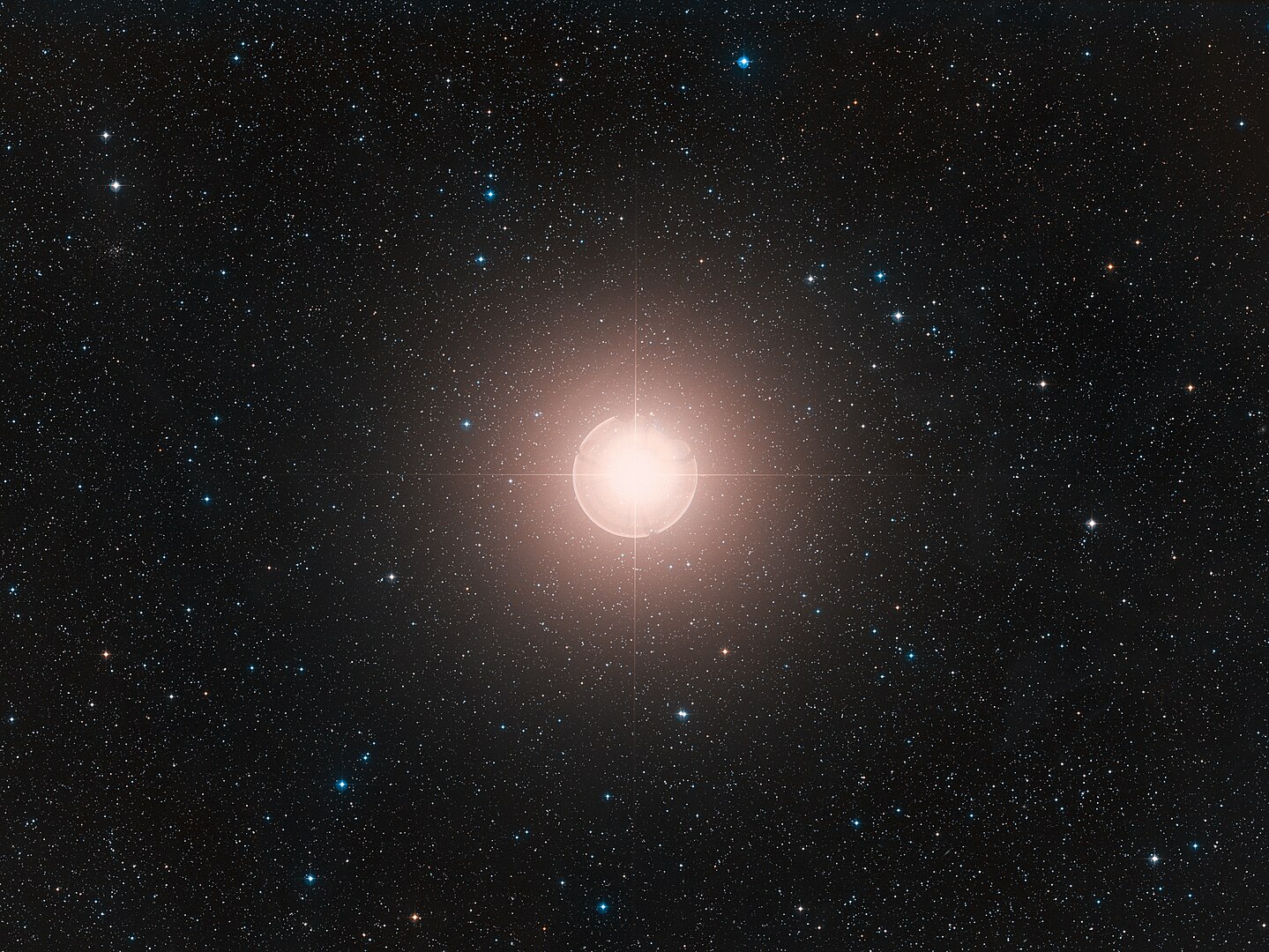
Betelgeuse is one of the most distinctive and fascinating stars visible in our night sky. Located in the constellation Orion, it stands out primarily because of its intense red color, which is easy to spot with the naked eye. It’s a huge, cool star that may soon end its life in a spectacular supernova explosion.
What is Betelgeuse? Get to Know One of the Largest Stars in the Sky
Betelgeuse is one of the best-known and most characteristic stars visible from Earth. It belongs to the group of red supergiants — stars that are in the late stages of their life cycle. This means Betelgeuse has already passed most of its life and is now slowly “aging.” Its age and massive size make it behave differently from our Sun, which is a main-sequence star.
Betelgeuse is located about 700 light-years from Earth, which is relatively close considering the vastness of the Universe. This means the light we see today left Betelgeuse around seven centuries ago. When we look at Betelgeuse, we are actually seeing the “past” of this star.
Moreover, Betelgeuse is one of the largest stars visible from Earth — its size is truly impressive. If we placed it where our Sun is, it would extend out to Jupiter’s orbit, encompassing nearly the entire inner planetary system. This gives us an idea of how enormous this red supergiant really is.
Betelgeuse is also one of the brightest stars in the night sky. Its red color makes it stand out among other stars and allows easy identification, especially in the Orion constellation. Because of this, Betelgeuse has fascinated astronomers and stargazers for centuries.
In summary, Betelgeuse is not just a red supergiant but a symbol of the power and transience of stars that we can admire in our winter sky.
Why Is It So Red? Understanding the Color of One of the Most Beautiful Stars
Betelgeuse stands out in the night sky primarily because of its intense red color. But where does this redness come from? It all starts with the star’s surface temperature. Betelgeuse is relatively cool for a star — its surface temperature is about 3500 degrees Celsius. Compared to the Sun, which is hotter with a temperature of about 5500 degrees Celsius, Betelgeuse is much cooler.
Lower temperature means the light emitted by Betelgeuse has a different wavelength distribution. Cool stars shine with longer wavelengths, which fall in the red part of the visible spectrum. That’s why Betelgeuse appears so intensely red — it’s the natural color of its surface.
By comparison, our Sun, being hotter, emits light that looks whiter or more yellow. Betelgeuse, thanks to its “cool” surface, gives us warm, red light, which is not only beautiful but also helps astronomers easily recognize it in the sky.
It’s also worth noting that Betelgeuse is a very large star with a diffuse atmosphere, which causes its light to be scattered and absorbed by various elements, enhancing the impression of a warm, reddish glow.
Will Betelgeuse Explode? What We Know About the Future of the Red Supergiant
Betelgeuse is a star in the final stage of its life, which means its days are numbered — at least in astronomical terms. Scientists agree that in the future, Betelgeuse will end its life in a spectacular explosion called a supernova. However, it’s important to emphasize that “in the future” is a relative term — on a cosmic scale, this could mean anywhere from a few thousand to even a million years.
The Betelgeuse supernova explosion will be an extraordinary event visible from Earth with the naked eye. When Betelgeuse explodes, its brightness will suddenly increase and, for some time, it will become brighter than all other stars in the sky, even visible during the day! This phenomenon will not only amaze observers but also allow scientists to better understand the processes that occur during the death of massive stars.
Observations of the star are carried out very carefully and continuously, as scientists try to catch the first signs of the upcoming explosion. In recent years, it has shown some unusual behavior, such as changes in brightness, which sparked significant interest and speculation about its condition.
Betelgeuse and Our Life — Should We Be Afraid?
The star, although relatively close to us — about 700 light-years away — does not pose a threat to life on Earth. Its potential supernova explosion is a fascinating astronomical event that can bring many scientific benefits but will not negatively affect our planet.
Thanks to its “close” neighborhood, this star is an exceptionally interesting object of study for astronomers. Observing it helps us better understand how massive stars live and die, and how elements essential to life, like carbon and iron, are created and spread.
For ordinary sky watchers, the star is a symbol of the beauty and majesty of the cosmos. Its intense red color and enormous size make it easy to find in the winter sky, and its glow fascinates generation after generation of observers. It’s a celestial body that inspires us to look up and ponder the mysteries of the Universe.
In conclusion, although this star does not directly affect our daily lives, its presence and future changes are an important part of the astronomical landscape and a source of knowledge about the cosmos that surrounds us.



0 Comments