

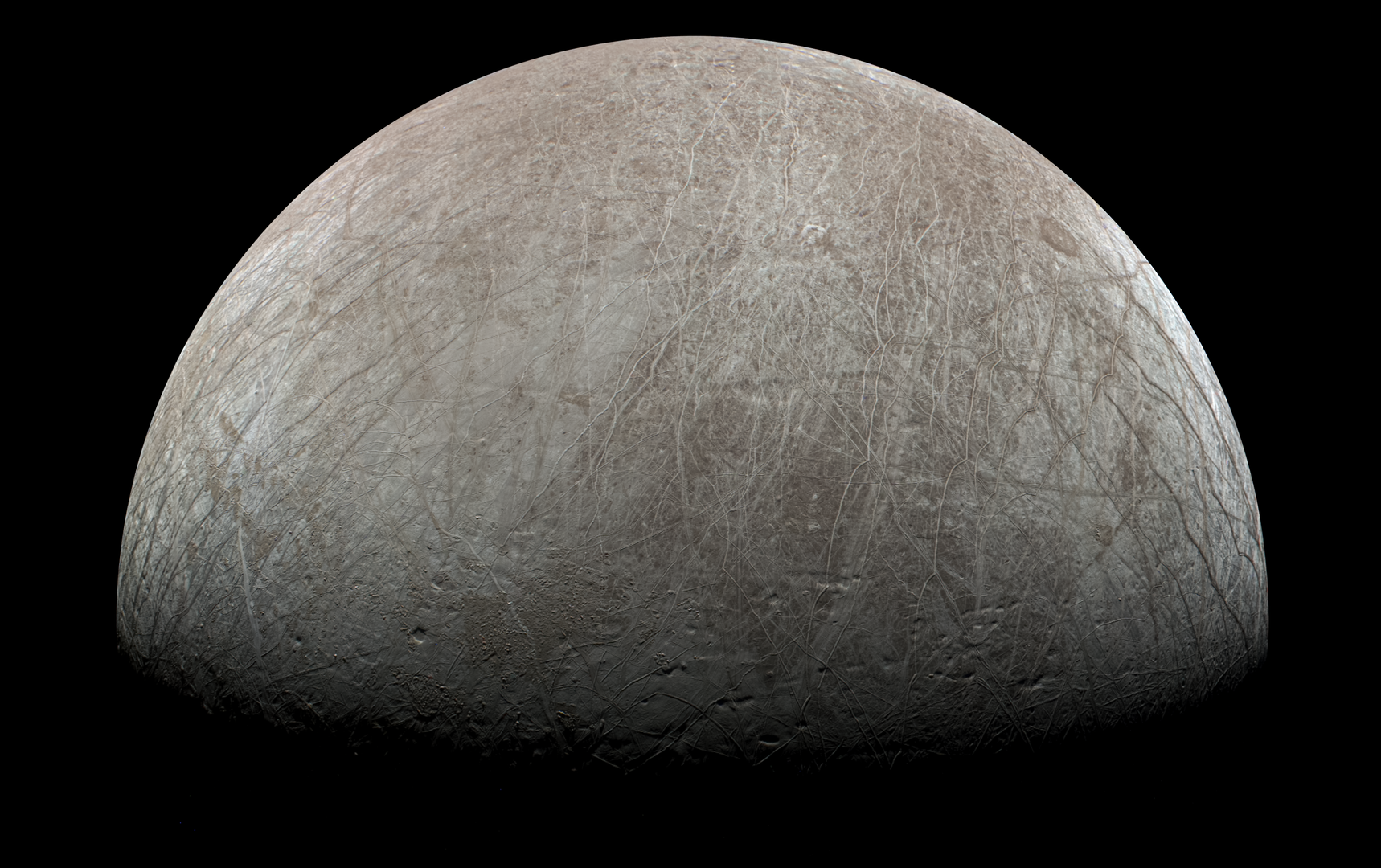
The surface of Europa moon, one of Jupiter’s largest moons, is constantly changing—according to a new study led by Ujjwal Raut from the Southwest Research Institute. By combining laboratory experiments with spectral data gathered by the James Webb Space Telescope (JWST), scientists have concluded that Europa’s icy shell is dynamic and ever-shifting, shaped by both external forces and internal geological processes.
Crystalline vs. Amorphous Ice
On Earth, water freezes into a well-ordered crystalline structure with a hexagonal pattern. On Europa, however, the ice is constantly bombarded by charged particles from Jupiter’s magnetosphere, disrupting this orderly arrangement. As a result, amorphous ice is formed—a kind of ice with a disordered molecular structure. For a related example of icy worlds in the Solar System, see our article on The Heart of Pluto is Cooling: Evidence of a Freezing Ocean Written on Its Surface, which explores how Pluto’s subsurface ocean is freezing and how ice behavior records planetary history.
Thanks to laboratory simulations, researchers were able to estimate the rate at which crystalline ice converts into amorphous ice and the reverse process of recrystallization. Particular attention was given to areas where Europa’s surface is highly irregular and complex—full of ridges, cracks, and chaotic terrain.
Clues from Beneath the Ice
JWST data confirmed the presence of amorphous ice not only on the surface but also just beneath it, especially in a region known as Tara Regio, a geologically chaotic zone. In this area, traces of sodium chloride (table salt) were also found—likely originating from Europa’s subsurface ocean. Additionally, scientists identified signs of carbon dioxide (CO₂) and hydrogen peroxide (H₂O₂)—compounds that may be significant in the search for life.
“The chemistry of this world is truly strange and exciting. Our data showed strong signs that what we’re seeing must be coming from the interior—possibly from an ocean about 30 kilometers beneath the ice,” explains Raut.
Europa Moon of Extraordinary Potential
Europa is one of Jupiter’s 95 known moons and one of the most fascinating objects in the Solar System. With a diameter of about 3,100 kilometers, it’s just slightly smaller than Earth’s Moon. Its surface is almost entirely covered in ice, under which is believed to lie a global ocean of liquid water—containing more water than all of Earth’s oceans combined.
Surface temperatures on Europa hover around –160°C (–256°F), which means water freezes into a thick shell. However, thermal energy from gravitational tidal forces caused by Jupiter may keep the subsurface ocean in a liquid state—potentially offering a habitat for simple forms of life.
The Future of Europa Research
The findings enabled by JWST mark another major step in understanding the conditions on Europa. In the coming years, NASA is preparing the Europa Clipper mission, scheduled to launch in 2024 and arrive by 2030. This spacecraft will study Europa’s surface, chemical composition, and internal structure, searching for signs of life and analyzing the properties of the ocean beneath the icy crust. For more on how JWST is revolutionizing our view of Europa and other celestial bodies, see our article on James Webb Space Telescope: A New Era of Astronomical Discoveries.



0 Comments