

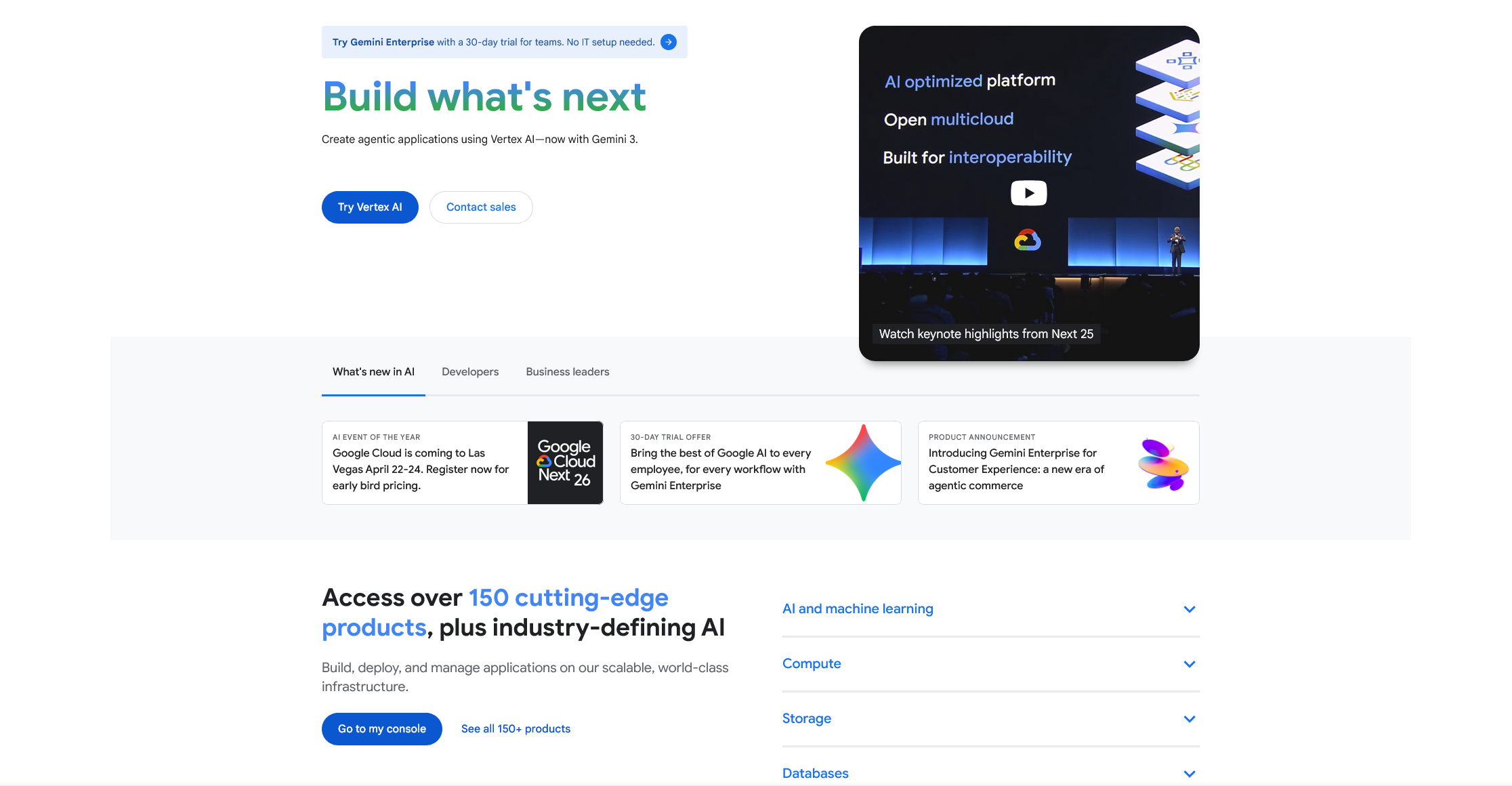
Google Cloud is aggressively expanding its reach in early 2026, forging major partnerships and rolling out new AI-driven features. Recent announcements highlight collaborations with telecoms and enterprise partners, enhancements to its AI and developer toolset, and massive data center investments worldwide. Below we break down the key developments:
In one example of Google’s cloud branding, a Google Cloud sign at a developer event underscores the company’s growing focus on cloud platforms. Tech industry news sites report that Google Cloud is extending Gemini AI models into new ecosystems. For instance, Google Cloud and cable operator Liberty Global inked a 5-year strategic AI partnership to “deploy Google’s Gemini AI models and other cloud tools across” Liberty’s European operations. This deal will power new services – including Gemini-driven search and discovery on Liberty’s Horizon TV platform – and aims to “improve network reliability and security” and even use spare capacity in Liberty’s data centers. Google will also offer more devices (Pixel phones, smart home products) through Liberty’s brands, and target small-business cloud and AI services via the partnership.
Beyond telecom, Google Cloud has expanded enterprise alliances. Oracle now makes Google’s advanced Gemini models available through Oracle Cloud Infrastructure (OCI). Oracle customers can use Gemini 2.5 via OCI’s Generative AI service – integrated with Google Cloud’s Vertex AI – for multimodal tasks like video/image synthesis and code generation. And technology services firm NTT Data announced a global alliance with Google Cloud to “accelerate AI-powered cloud innovation” and bring agentic AI solutions to industry customers. NTT Data will build Google Agentspace/Gemini-based industry solutions (e.g. AI assistants for finance and travel), and train thousands of engineers on Google Cloud technology to scale these offerings.
Other partnerships focus on generative AI and collaboration. For example, in Brazil Google Cloud’s ecosystem is helping local companies deploy generative AI (via Vertex AI and Agentspace) for customer service and analytics, according to a market report. In short, Google Cloud is embedding its AI tools deeper into telecoms, enterprise and public sector customers worldwide.
Google Cloud’s New AI Tools and Models
On the product side, Google Cloud is rapidly evolving its AI toolkit. Throughout 2025 it expanded the Gemini model family and related developer tools, setting the stage for 2026 innovation. In early 2025, Google launched Vertex AI RAG Engine, a managed retrieval-augmented generation service to reduce hallucinations and improve trust in AI apps. It also released new open models (Gemini 2.5 and Gemma 3) and rolled out AI Protection features to secure enterprise AI workloads. In spring 2025, Google introduced creative AI tools: Veo 3.1 for next-gen video generation, Imagen 4 for image creation, and Lyria 2 for music synthesis, along with a new coding assistant “Jules” and a Gemini CLI that lets developers deploy and debug without leaving their terminal.
By late 2025, Google unveiled Gemini Enterprise, a new AI platform bringing Google’s best models to the workplace, and Gemini 3 (its most advanced model) for agents and reasoning tasks. It also made its latest hardware (e.g. Ironwood TPUs and Axion chips) generally available to power these compute-heavy models. Google Cloud’s Vertex AI likewise gained improvements: in November 2025 it added Agent Builder capabilities to better build, scale and govern AI agents (reusable software “bots”) across their lifecycle. For developers, Google introduced Gemini CLI extensions – for example, a /security:analyze command to scan code for security issues, and a /deploy command to push apps to Cloud Run – streamlining AI app development.
In summary, Google Cloud’s stack now includes advanced generative AI models (multimodal Gemini, “Nano Banana” image blending models, etc.) and supporting services like managed inference, security guardrails, and open AI tool integrations. These make it easier for enterprises to adopt AI in search, content creation, analytics and automation.
Revamped Partner Network and Ecosystem
Google Cloud is also transforming its partner ecosystem. A new Google Cloud Partner Network will roll out in Q1 2026, replacing the old Partner Advantage program. This revamped program introduces three partner tiers – Select, Premier and a new Diamond level – and shifts from task-based requirements to rewarding actual customer outcomes. Partners will earn rewards for co-selling with Google, delivering high-quality services, and co-innovation (especially involving ISVs), rather than merely submitting paperwork.
Crucially, Google is baking AI into the partner experience. The new program includes an AI-powered Partner Network Hub that automates tracking of certifications, sales influence and delivered solutions. For example, Google says partners will automatically get credit in the system for any successful customer engagement – eliminating redundant reporting. It even uses AI in a new “SOW Analyzer” to speed up approval of partner project proposals. Overall, the goal is to let partners focus on customers while the program handles admin via AI and simpler metrics.
Infrastructure and Global Expansion
On the infrastructure front, Google Cloud is committing huge sums to expand its global data centers. This growth is driven by rising AI demand. In the US, it recently pledged about $40 billion in Texas for three new AI-ready data centers by 2027. This makes Texas Google’s single largest investment in any state.
Additionally, Google will invest $9 billion in Oklahoma over two years. This funding will support new cloud/AI campuses, including a data center in Stillwater and an expansion in Pryor, as well as workforce training programs. Internationally, Google has allocated €5.5 billion in Germany for cloud/AI infrastructure through 2029. Projects include a new data center in Dietzenbach and upgrades to Hanau.
These initiatives expand Google Cloud’s regional low-latency zones, supporting customers like automakers and manufacturers who require onshore AI compute. Google’s data center facilities, such as this one in Taiwan, now feature the Google logo and state-of-the-art cooling systems.
These investments are part of Google Cloud’s plan to reach 42 cloud regions globally. Facilities will run on 24/7 carbon-free power with advanced security. The Texas and Germany builds include renewable energy partnerships and grid innovations, such as wind and battery projects in Europe. These measures ensure clean, reliable power. In the US, the Texas buildout will create thousands of jobs and STEM training programs. This reflects a broader push to grow the AI workforce alongside increasing data center capacity.
Together, these moves—partnership deals, AI platform launches, and massive infrastructure spending—highlight Google Cloud’s 2026 strategy. The company aims to embed its AI and cloud services in every industry and region. Gemini and other innovations will help differentiate Google Cloud from competitors. These updates reinforce its position as a leading AI-driven cloud provider.
Sources: Authoritative tech and financial news outlets including Google Cloud Press Releases, Reuters
FAQ – Google Cloud
Google Cloud has announced several strategic alliances. Notably, it struck a 5-year AI pact with Liberty Global. The deal uses Google’s Gemini models to power consumer services across Europe, including AI-driven search on Horizon TV.
It also expanded its agreement with Oracle, allowing Gemini AI to run inside Oracle Cloud Infrastructure. This lets Oracle customers access Google’s top models within OCI and Oracle applications.
Another major partnership is with NTT Data. The companies will combine NTT’s system integration expertise with Google’s AI and cloud technology to co-develop industry solutions. They also plan to certify thousands of engineers in Google Cloud technology.
Google Cloud has rapidly rolled out new generative AI tools. For example, it launched the Vertex AI RAG Engine to improve LLM reliability and released new multimodal models (such as Gemini 3 for text and Nano Banana for image editing). In late 2025 it debuted Gemini Enterprise for workplace AI and made advanced hardware (Ironwood TPUs) generally available. Developer tools were also updated: Vertex AI gained an Agent Builder for AI agent governance, and Google added Gemini CLI security and deployment extensions. These advances make it easier for organizations to build AI-powered apps, agents and content pipelines on Google’s infrastructure.
Early 2026 will see a revamped partner program. Google Cloud will introduce three tiers (Select, Premier, Diamond) and shift to an outcome-based model. Rather than tracking plans and paperwork, the new program rewards partners for actual customer successes, co-sales, innovation and service quality. It also integrates AI to simplify operations: an AI-driven Partner Hub will automatically track partner certifications and achievements so users don’t have to manually submit everything. In short, the program is designed to make it easier for partners to gain recognition and focus on delivering customer value.
Google is spending tens of billions on data centers. In late 2025 it announced a $40 billion investment in three new Texas data centers (to be completed by 2027) to boost AI capacity. It separately committed $9 billion in Oklahoma for new cloud campuses and workforce education. In Europe, Google earmarked €5.5 billion in Germany for new data centers and grid improvements. These funds will expand Google Cloud’s global footprint (42 regions strong) with state-of-the-art facilities that support AI workloads and renewable energy goals.
Google has embedded security in its AI offerings. It launched AI Protection, a suite of tools to guard AI workloads across clouds. For developers, it introduced security auditing and policy features (e.g. the Gemini CLI /security:analyze command). Governance is also improving via Google Cloud’s partner program: new advanced competencies (like an AI competency) and automated oversight tools ensure partners meet compliance and quality standards. Google Cloud’s focus is on making AI both powerful and trustworthy for enterprise use.


0 Comments