

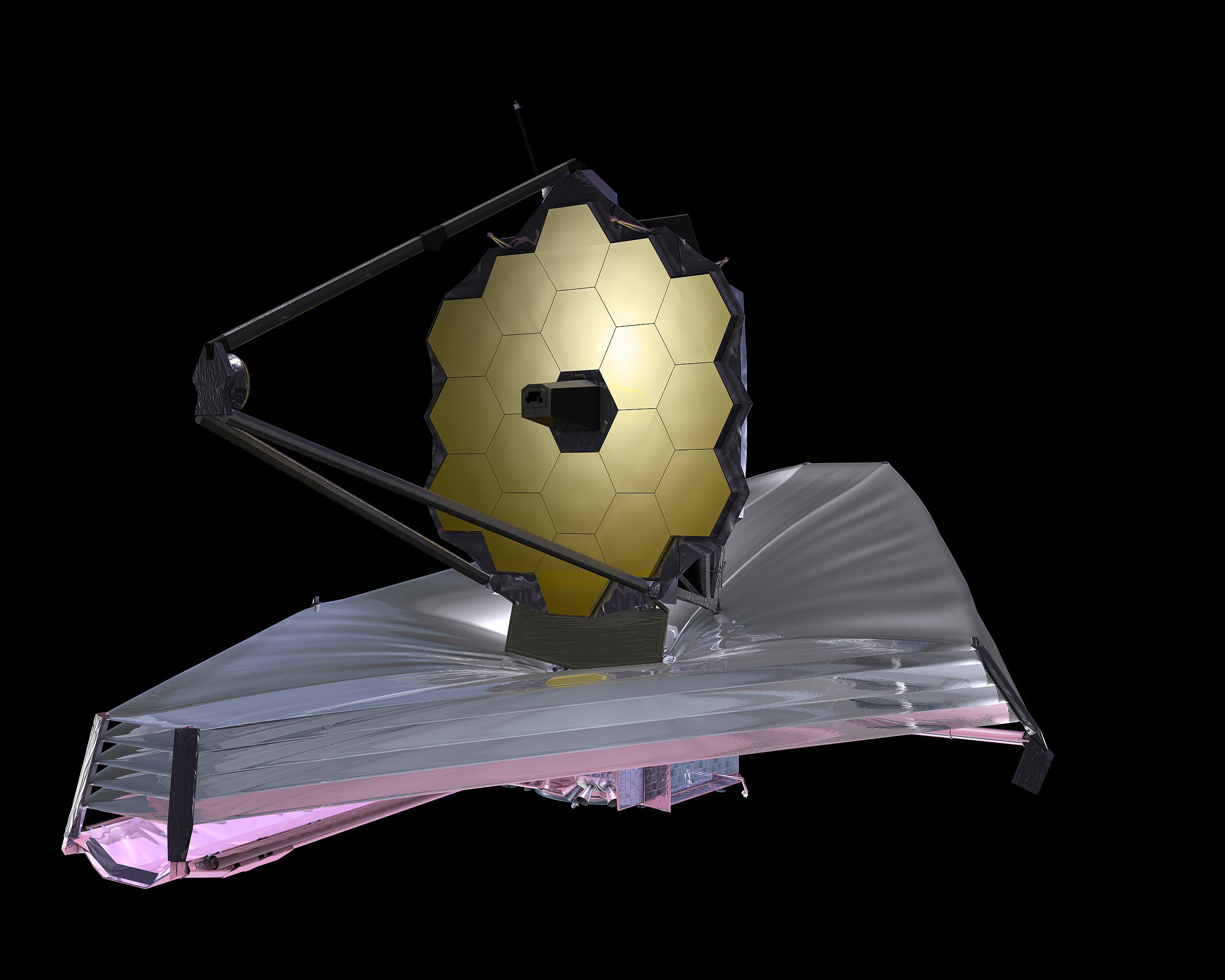
The universe is full of mysteries that have fascinated humanity for centuries. From the first naked-eye observations of the sky, through Galileo’s telescope, to advanced ground-based and space observatories, our knowledge of the cosmos continues to expand. One of the most recent and groundbreaking tools in the hands of astronomers is the James Webb Space Telescope (JWST), which opens an entirely new window into the Universe.
What is the James Webb Space Telescope?
The James Webb Space Telescope, often referred to as the successor to the famous Hubble Telescope, is a joint project between NASA, the European Space Agency (ESA), and the Canadian Space Agency (CSA). Launched in December 2021, it was designed primarily for infrared observations of the Universe. Infrared light allows astronomers to see the most distant objects — such as the first stars and galaxies — because their light is stretched (redshifted) by the expansion of the cosmos. Infrared observations also let scientists peer through dense clouds of cosmic dust that block visible light, enabling the study of star and planet formation regions. For an official overview from NASA about how Webb works and its mission goals, see the NASA James Webb Space Telescope page.
Key Features of JWST
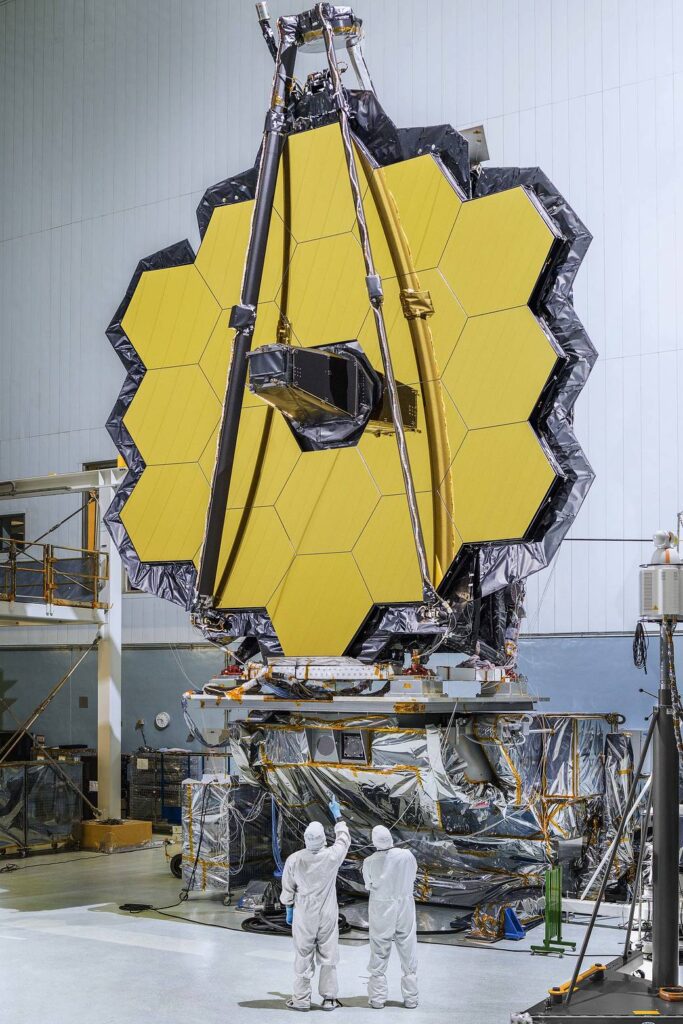
- Huge Primary Mirror: Composed of 18 hexagonal gold-coated segments, with a total diameter of 6.5 meters. A larger mirror means greater light-collecting ability, which allows the observation of fainter and more distant objects.
- Advanced Scientific Instruments: JWST is equipped with four main instruments: NIRCam (Near-Infrared Camera), NIRSpec (Near-Infrared Spectrograph), MIRI (Mid-Infrared Instrument), and FGS/NIRISS (Fine Guidance Sensor/Near-Infrared Imager and Slitless Spectrograph). Each serves a specific purpose, from capturing images to analyzing the chemical composition of distant objects. For example, recent discoveries of Europa’s surface and atmosphere have been revealed thanks to these instruments, as detailed in our article on Europa: A Moon in Constant Motion – New Discoveries Thanks to the James Webb Telescope.
- Orbit and Cooling: The telescope is located at the second Sun-Earth Lagrange point (L2), about 1.5 million kilometers from Earth. This location provides stable thermal conditions and shields the telescope from Earth’s and the Sun’s radiation. To function properly in infrared, the instruments must be kept at extremely low temperatures (below –220°C), which is achieved through a tennis-court-sized sunshield and specialized cooling systems.
Groundbreaking Discoveries by JWST
Since beginning full scientific operations in July 2022, JWST has delivered stunning data and images that are revolutionizing our understanding of the cosmos.
- The Earliest and Most Distant Galaxies: One of JWST’s primary goals is to study the early Universe. The telescope has already identified galaxy candidates that existed just a few hundred million years after the Big Bang. These observations provide invaluable information on how the first cosmic structures formed. For example, programs like JADES (JWST Advanced Deep Extragalactic Survey) have revealed galaxies whose light has traveled over 13 billion years. Some of these early galaxies appear surprisingly massive and evolved, challenging current cosmological models.
- Exoplanet Atmospheres: JWST is revolutionizing the study of exoplanets. Thanks to its sensitive spectrographs, the telescope can analyze the chemical composition of atmospheres around distant worlds. Within its first months of operation, JWST confirmed the presence of water vapor, carbon dioxide, and even clouds in the atmospheres of exoplanets like the gas giant WASP-96b and the smaller planet GJ 1214 b. These studies are crucial in the search for potentially habitable planets and the detection of so-called biosignatures—chemical signs of life.
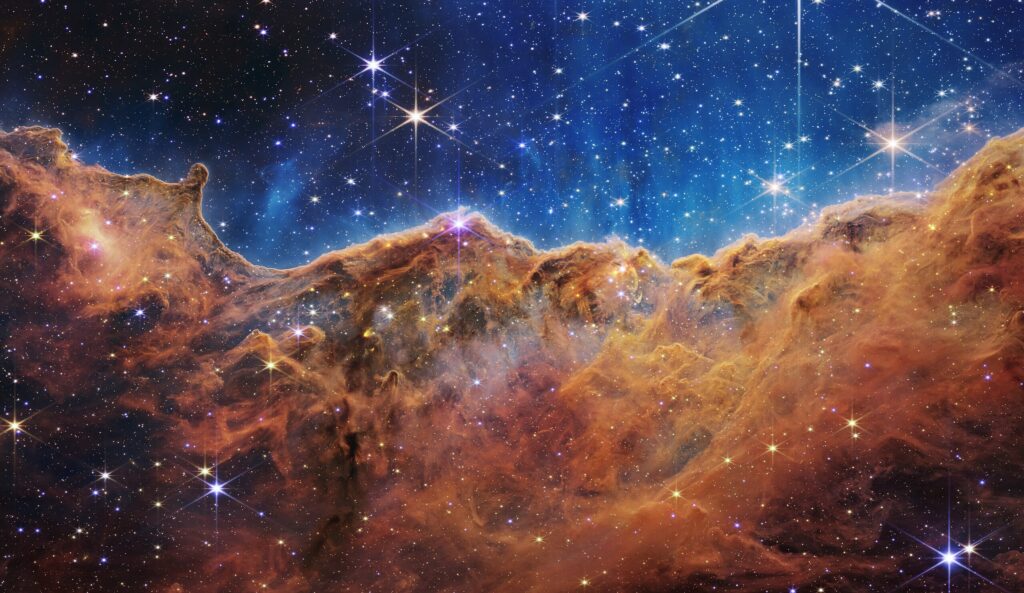
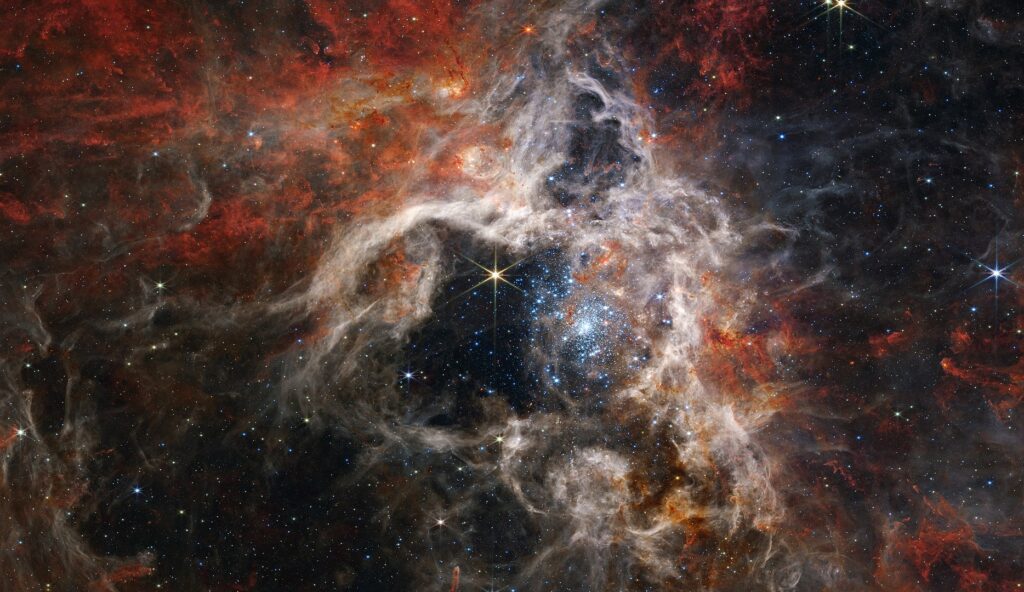
- Birth and Death of Stars: JWST’s incredible infrared resolution allows scientists to observe the details of star and planetary system formation processes that were previously hidden by dust. Spectacular images of nebulae like the Carina and Tarantula Nebulae show young, hot stars and complex gas and dust structures that give rise to new generations of stars. Just as fascinating are images of stars in their late evolutionary stages, such as the Southern Ring Nebula, which provide insights into how stars disperse material back into space, enriching it with elements essential for new cosmic bodies.
- Solar System Objects: Though designed to observe the distant Universe, JWST also provides extraordinary data about our cosmic neighbors. Observations of Jupiter have revealed details of its auroras, dynamic storms, and faint rings. The telescope has also observed Mars, the ice giants Uranus and Neptune, as well as smaller bodies like asteroids and comets, shedding new light on their composition and evolution.
Importance and Future of the Mission
The James Webb Space Telescope is not only a technological marvel but, above all, a powerful scientific tool that is already changing our view of the Universe. Every new image and dataset carries the potential for discoveries that could answer fundamental questions about our origins, the evolution of the cosmos, and the possibility of life beyond Earth.
JWST’s mission is planned to last many years, and scientists worldwide eagerly await more data. The telescope’s discovery potential is immense, and it will undoubtedly continue to surprise us with breathtaking images and groundbreaking insights—extending the golden age of space exploration.
Example Images
Advanced Engineering of the James Webb Space Telescope – Technical Details
While the breathtaking images from the James Webb Space Telescope fire the imagination, its technical specifications are equally impressive. JWST is the most advanced observatory ever built, not just a “successor to Hubble,” but a new class of infrared space instrument, designed to look farther back in time and space than ever before.
Here are the key components and systems that enable this ambitious mission:
🔭 Primary Mirror – The Heart of the Telescope
The most iconic feature of JWST is its massive, segmented primary mirror measuring 6.5 meters in diameter—more than twice the size of Hubble’s. It is made of beryllium, a light and strong metal that maintains its shape in extreme temperatures. Each segment is coated in a thin layer of gold, ideal for reflecting infrared light, and protected with a layer of silicon dioxide.
☀️ Sunshield – Thin as Foil, Essential for Success
To operate in the infrared, the telescope must remain extremely cold and in near-total darkness. This is achieved by a five-layer sunshield made of Kapton film coated with aluminum and doped silicon. Measuring about 21 by 14 meters—roughly the size of a tennis court—it creates an extreme temperature gradient: around +85°C on the sun-facing side to as low as –233°C on the instrument side.
🧪 Scientific Instruments – JWST’s Four Eyes
The telescope features four advanced instruments for various types of observations, from the earliest galaxies to exoplanet atmospheres:
- NIRCam – The main near-infrared camera, ideal for capturing light from the oldest and most distant objects in the Universe.
- NIRSpec – A spectrograph that can analyze the spectra of over 100 objects simultaneously, revealing their chemical composition.
- MIRI – A unique mid-infrared instrument requiring additional cooling to temperatures near absolute zero—just 7 K!
- FGS/NIRISS – A precision guidance system and auxiliary spectrograph, supporting exoplanet studies and more.
🔍 Optical System and Working Range
JWST is a three-mirror anastigmat (Korsch-type) telescope, meaning it uses a convex secondary mirror, a tertiary corrective mirror, and a “fine steering mirror” for image stabilization. It operates in wavelengths from about 0.6 to 28.5 microns—from orange visible light to the mid-infrared.
🌌 Location and Operating Environment
Unlike Hubble, which orbits Earth, JWST resides about 1.5 million kilometers away at the Sun-Earth L2 Lagrange point. This position ensures stable observation conditions, far from thermal and light interference.
🚀 Launch and Mass
JWST was launched into space on December 25, 2021, aboard an Ariane 5 rocket from the Guiana Space Centre in Kourou. Its total mass was about 6200 kg (including fuel), with most of the weight attributed to the telescope structure and scientific instruments.
🧊 Operating Temperatures
Thanks to its sunshield and cryogenic cooling systems, JWST operates in extremely low temperatures:
- Cold side: below 50 K (–223°C)
- MIRI instrument: cooled to below 7 K (–266°C)
- Hot side (sunshield exterior): up to ~85°C
Telescope Size Comparison
Source: NASA


0 Comments