

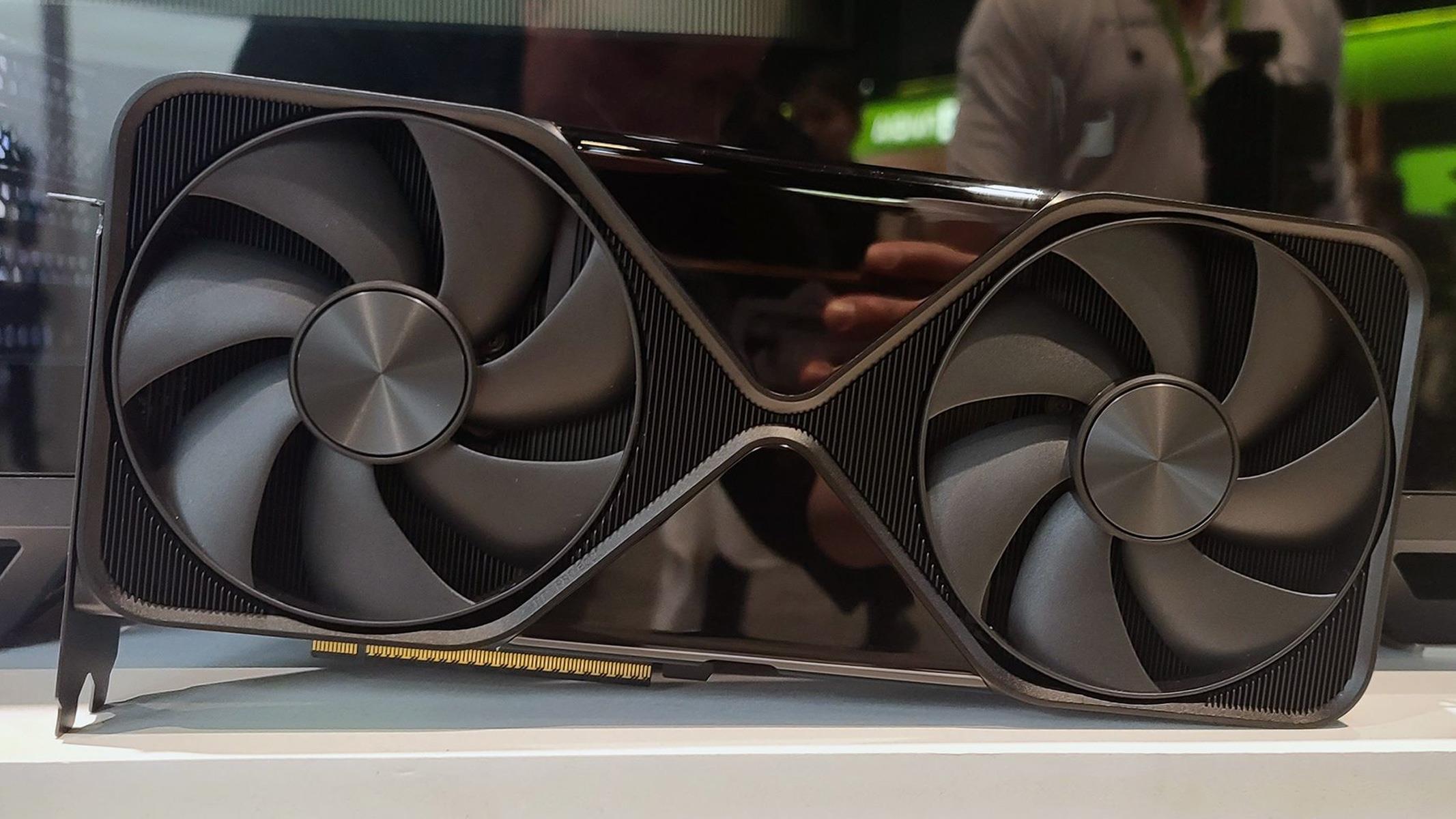
The NVIDIA RTX PRO 6000 Blackwell is a high-end professional workstation GPU designed for demanding AI, 3D rendering, and video production tasks. Built on the Blackwell (GB202) architecture using TSMC’s 4 nm process, the card features 24,064 CUDA cores, 752 Tensor cores (5th Gen), and 188 RT cores (4th Gen). It comes with 96 GB GDDR7 ECC memory on a 512-bit bus, offering a massive 1792 GB/s bandwidth. Base clock is ~1590 MHz, with a boost up to ~2617 MHz, delivering a theoretical FP32 performance of 125 TFLOPS.
The card uses a dual-slot “double flow-through” cooling design, supports PCIe 5.0 x16, and has four DisplayPort 2.1 outputs. Maximum power draw is 600 W, requiring a single 16-pin PCIe (12VHPWR) connector.
| Category | Specification |
| GPU | NVIDIA GB202 (Blackwell), TSMC 4 nm, 92.2 B transistors, 750 mm² die |
| Execution Units | 24,064 CUDA, 752 Tensor, 188 RT, 192 ROP, 1505 MB L2 cache |
| Memory | 96 GB GDDR7 ECC, 512-bit, 1792 GB/s, 28 Gbps effective |
| Clocks | 1590 MHz base, ~2617 MHz boost |
| Interface | PCIe 5.0 x16 |
| Video Outputs | 4× DisplayPort 2.1 (8K@240 Hz, 16K@60 Hz with DSC) |
| Power / PSU | 600 W TDP, 1× 16-pin PCIe, recommended PSU ≥850 W |
| Dimensions | 241 × 111 × 40 mm, dual-slot, double flow-through |
| Technologies | DirectX 12 Ultimate, Vulkan 1.4, OpenGL 4.6, CUDA 12, DLSS4, NVENC/NVDEC gen 4/5 |
| Theoretical Perf. | FP32 125 TFLOPS, Tensor 4000 TOPS (FP4 sparse) |
| Launch | 2025, price ~$8,000 |
Blackwell Architecture and Performance
The card is based on the new Blackwell architecture, which, according to NVIDIA, delivers a radical acceleration in AI and compute tasks compared to the previous Ada generation. For example, the company reports 2.5× faster AI model training on Blackwell GPUs compared to the RTX 6000 Ada.
A large number of CUDA cores and 5th-generation Tensor cores (with FP4 precision support and DLSS 4) make the RTX PRO 6000 well-suited for training and fine-tuning large language models (LLMs) or generative networks. With 96 GB of GDDR7 memory, the card can handle very large datasets – enabling high-resolution simulations, complex 3D scenes, or processing huge video files. Compared to a top consumer GPU (e.g., the GeForce RTX 5090), the RTX PRO 6000 has more cores (24,064 vs. 21,760) and significantly more memory (96 GB vs. 32 GB), translating into higher performance in memory-intensive tasks.
Gaming Performance (Approximate)
Although the card is not designed for gaming, tests by GamersNexus show that the RTX PRO 6000 achieves a slight advantage over the GeForce RTX 5090 based on the same core. For example, in Final Fantasy XIV at 4K resolution, it averaged around 208 FPS, while the RTX 5090 reached 184 FPS (an increase of ~13%). In Starfield at 4K, it recorded about 115 FPS (7% more than the 5090). Differences in 1080p/1440p gaming are usually a few percent in favor of the PRO 6000 (e.g., ~10% in FFXIV at 1440p). This is mainly due to higher clock speeds and better utilization of memory bandwidth under the limitations imposed by the high-end test CPU. Overall, in practice, the RTX PRO 6000 performs better in professional applications (rendering, AI, simulations, video editing) rather than gaming.
Cooling and Housing
The RTX PRO 6000 Blackwell uses reference double flow-through cooling. The card has a dual-slot design with two large axial fans mounted on the front panel of the housing. Air is drawn in from the front and pushed through a massive heatsink with multiple copper heat pipes and aluminum fins, then expelled from both ends of the card (top and bottom of the case). This solution ensures efficient airflow along the entire length of the heatsink (the “Double Flow-Through” version), which is crucial given the 600 W TDP. In practice, the reference cooler maintains reasonable temperatures even under full load, though noise can be noticeable (the card requires active cooling due to high TDP). Additionally, the design provides mounting stability – all electronics and memory modules are protected by a metal shroud and a rigid backplate for reinforcement.
Materials and Build Quality
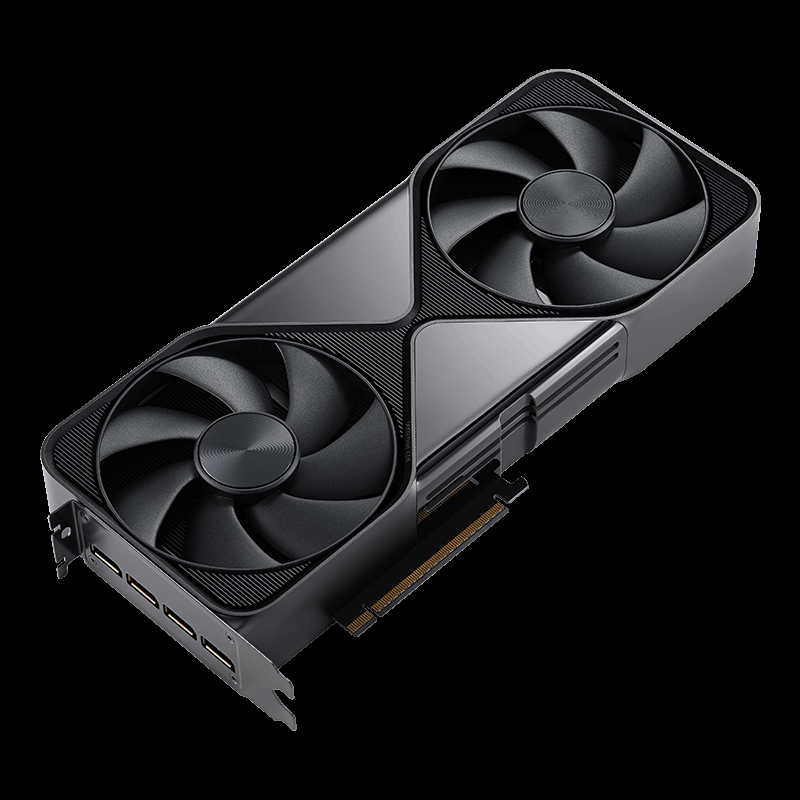
The card’s casing follows the typical design of NVIDIA reference GPUs in the Workstation Edition style. The front is dominated by a matte black plastic shroud that conceals the cooling components and gives the card a professional look. At the back, there is a solid metal backplate with the “RTX PRO 6000 Blackwell” logo printed on it, which reinforces structural rigidity and helps passively dissipate heat from the cooling system.
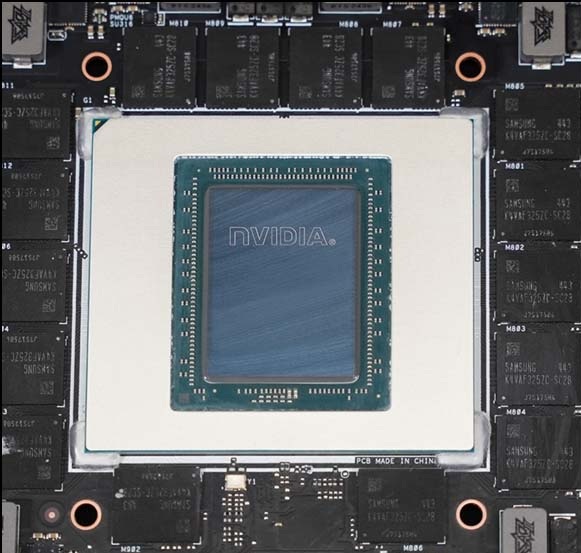
The interior of the card is densely packed – on a ~30 cm PCB, there are 16 memory modules on each side of the GPU core, along with extensive power delivery and cooling circuits. High-quality components are used under the hood – copper heat pipes make precise contact with the GPU die and thermal pads are applied to the memory and power sections. The manufacturer opted for thermal paste instead of liquid metal between the GPU and heatsink, as confirmed by GamersNexus teardown reports.
Overall, the card feels solid and well-built, typical of the RTX PRO professional series – it is heavy (~1.95 kg), but well-fitted and ready for continuous, 24/7 operation.
Rear View of the NVIDIA RTX PRO 6000 Blackwell – metal backplate with the model name. The backplate reinforces the structure and aids passive heat dissipation. Note the four DisplayPort 2.1 outputs – the absence of HDMI is intentional to maintain signal synchronization compatibility in workstations.
Real-World Performance (Workstation)
NVIDIA emphasizes that the RTX PRO 6000 Blackwell is designed for demanding professional workloads. With 96 GB of VRAM, the card enables smooth creation and rendering of massive 3D scenes, engineering simulations, and large data set analysis. For example, in architectural visualization or CAD design, the advanced memory and RT cores allow real-time work with full global illumination.
In AI and ML tasks, Blackwell GPUs shorten training and inference times – neural networks (e.g., generative networks, LLMs) can be trained locally faster than ever, and the new RTX Neural Shaders feature automates texture and lighting generation using AI. DLSS 4 enables AI-driven resolution upscaling and faster rendering of images. In practice, this translates to higher productivity in digital content creation (DCC) applications – shorter animation render times, faster 8K video processing, and smooth multi-camera editing.
In scientific and HPC applications, the card proves its power. NVIDIA highlights accelerated fluid dynamics (CFD) simulations, genomics research, and geophysical simulations – in some cases, multiple times faster than CPU servers. One expert reports that Blackwell GPUs can be 4.5× faster than a 64-core CPU in CFD computations. The large memory capacity also allows working with large geographic models, massive neural networks, or Big Data analysis without data “swapping.” In short, the RTX PRO 6000 excels wherever maximum compute power on a single card matters – from visual effects studios to research labs and AI server rooms.
PCIe Interface and Video Outputs
The card uses a PCI Express 5.0 x16 interface, providing maximum bandwidth (~32 GB/s) and avoiding bottlenecks when communicating with the CPU/system memory. This ensures fast transfers of large data arrays (textures or tensors) between the GPU and the rest of the system. The RTX PRO 6000 is also backward compatible with PCIe 4.0/3.0, though on older boards (e.g., PCIe 3.0 x16), performance in ultra-demanding tasks may be slightly reduced – typically only a few percent in professional workloads.
The rear panel has four DisplayPort 2.1 outputs, supporting extreme-resolution monitors (e.g., 8K@240 Hz, 16K@60 Hz with DSC). The absence of HDMI is standard in workstations – with DP Sync (e.g., NVLink for video), multiple monitors can be easily set up in professional arrays. The card allows simultaneous connection of multiple high-resolution displays and fully supports modern graphics standards (HDR, wide color gamut), crucial for graphics, visualization, and video post-production work.
Power and Installation
Due to its high-end specifications, the RTX PRO 6000 requires a strong power supply. It uses a single 16-pin PCIe connector (CEM5) – the new 12VHPWR standard in ATX 3.0. In practice, the card consumes about 600 W, so a PSU of at least 850–1000 W is recommended, depending on the rest of the system.
A major advantage of the RTX PRO 6000 is that, unlike some consumer 40xx/50xx models, it does not require troublesome adapters – NVIDIA provides a factory 16-pin cable, so a compatible ATX 3.0 PSU is all that’s needed. This also reduces the risk of overheating pins (a known issue with 12-pin adapters). For comparison, many previous-generation top GPUs required 3× 8-pin connectors or a dedicated 12VHPWR, which often complicated installation. Here, one cable is sufficient, simplifying cable management in tight cases.
Why 16-pin?
✅ Broad compatibility – works with ATX 3.0 PSUs and ATX 2.0 via adapters (e.g., 3× 8-pin → 16-pin)
✅ Safer power delivery – designed for 600 W loads, minimizing voltage drops
✅ Cleaner setup – a single thick cable improves aesthetics and eases installation in compact cases
Summary
The NVIDIA RTX PRO 6000 Blackwell Workstation Edition is a card for demanding professionals. Its massive 96 GB of GDDR7 memory, powerful Blackwell architecture, and modern Tensor/RT cores eliminate previous memory and compute limitations. The card handles the most resource-intensive projects – from AI and deep learning, to 8K video editing, to complex engineering simulations. The reference “Double Flow-Through” cooling keeps temperatures under control, while the metal construction ensures durability.
Pros:
✅ 96 GB GDDR7 with ECC – record capacity for workstations
✅ Blackwell architecture – much higher AI/RT performance than predecessors (TF32: 125 TFLOPS, Tensor: 4000 TOPS)
✅ Efficient cooling – dual-fan double-flow design manages 600 W TDP
✅ 16-pin standard – easier installation than multiple 8-pin cables (ATX 3.0)
✅ Broad range of applications – 3D/VR rendering, machine learning, film production (DLSS4, Neural Shaders support)
Cons:
⚠️ Very high power consumption (600 W) requires a strong PSU (≥850 W)
⚠️ Price – around $8,000, making it an elite-class investment
⚠️ No HDMI – DisplayPort only (though typical for pro setups)
⚠️ Limited availability – may be hard to find due to niche market
Final Rating: 5/5
The RTX PRO 6000 Blackwell is currently one of the most powerful workstation GPUs on the market. It delivers performance and features that surpass the competition in the professional segment. The value of advanced technologies (96 GB VRAM, Tensor Cores, DLSS4, etc.) is indisputable for demanding workloads – though it comes at a high price and significant power requirements. For professionals seeking uncompromising GPU performance, the RTX PRO 6000 Blackwell is virtually unmatched.
0 Comments