

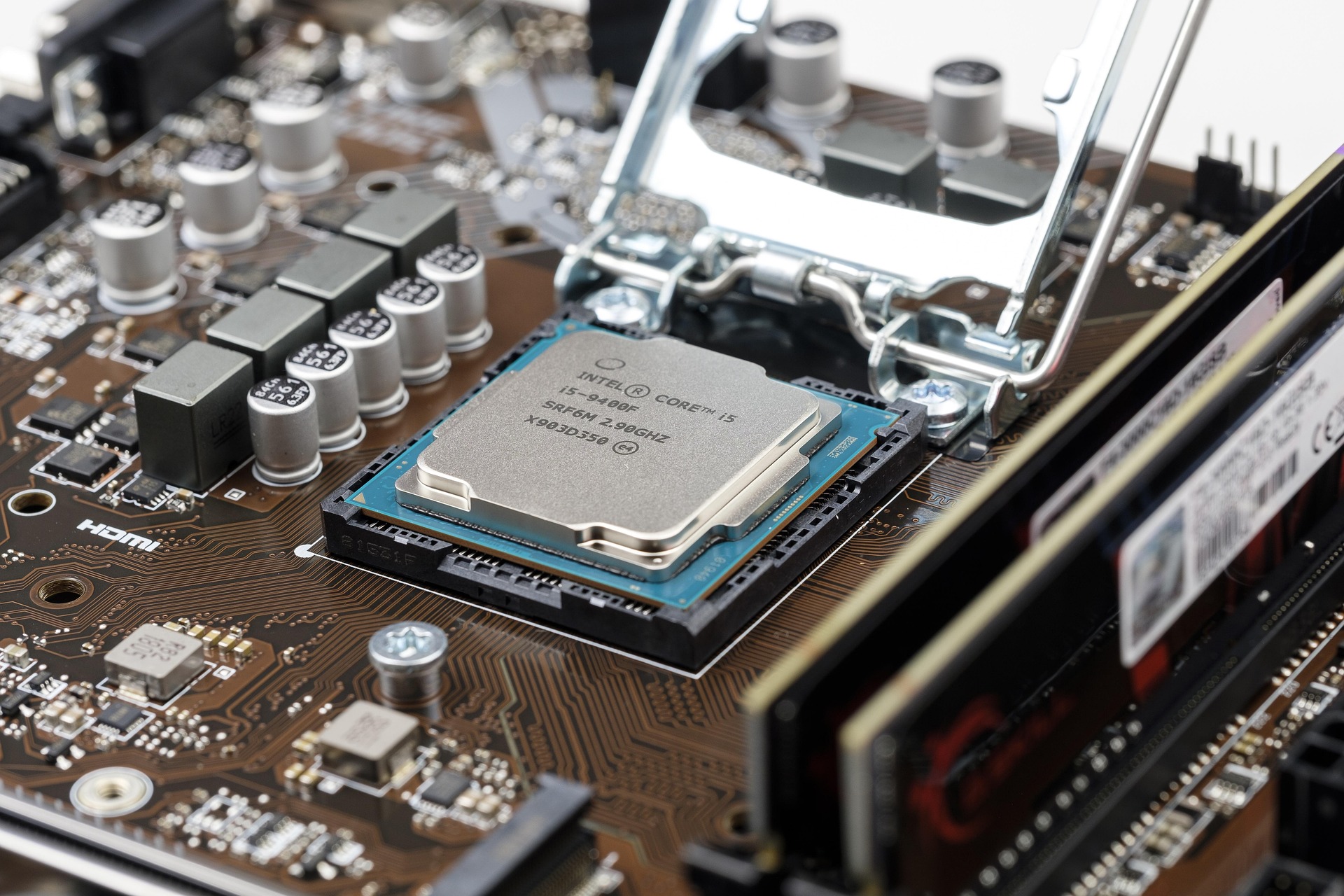
Integrated graphics from Intel (IGP – Intel Graphics Technology) began their dynamic development around 2010–2011, when the first Intel HD Graphics units debuted in Intel Core processors. These replaced the older Intel GMA (Graphics Media Accelerator) line.
In the early stages (Westmere architecture, Core 2 Duo processors), graphics were still integrated into the chipset. An example is the Intel GMA X4500, which offered very basic performance and lacked support for modern graphics standards.
A breakthrough came with the Clarkdale/Arrandale generation (2010), when for the first time, the integrated graphics unit was housed within the same package as the processor. Although the CPU and GPU were still separate dies on a single substrate (a multi-chip package), it marked an important step toward full integration. The first iGPUs in this architecture featured 12 execution units (EUs) and achieved performance between 24.0–43.2, setting a new direction for integrated graphics development.
Sandy Bridge – A Leap in HD Graphics
In 2011, Intel introduced the Sandy Bridge architecture — the first to feature a monolithic (single-die) integration of CPU and GPU on the same silicon. The new generation iGPUs, Intel HD Graphics 2000 and 3000, delivered a significant performance boost thanks to more EUs and architectural improvements. These units reached up to approximately 259.2 GFLOPS, enabling smooth playback of high-resolution video and the ability to run basic 3D games and applications.
The next generation, Ivy Bridge (2012), brought Intel HD Graphics 4000, offering around 332 GFLOPS of computing power and full support for DirectX 11. This significantly improved 3D graphics quality and the smoothness of modern applications. Additionally, Ivy Bridge was the first Intel generation to officially support up to three monitors simultaneously, provided the motherboard and system offered appropriate video outputs and hardware support.
From generation to generation, Intel added support for new graphics standards, such as DirectX 12, OpenGL 4.5, Vulkan, and modern video codecs (H.264, HEVC, VP9). New technologies like Intel Quick Sync Video also emerged, allowing rapid video encoding and decoding, useful in online streaming, video editing, and video conferencing.
Key Generations and Models
Intel’s integrated graphics (iGPUs) have undergone a massive transformation in recent years — evolving from simple units supporting basic UI rendering to powerful graphics engines capable of Full HD gaming and AI acceleration. Below is a chronological overview of Intel’s most important iGPU generations and their capabilities.
Intel GMA X4500 (G43/G45 Express Chipset, 2008)
The Intel Graphics Media Accelerator (GMA) X4500 was part of the G43/G45 chipset series (32 GFLOPS), designed primarily for desktop and mobile platforms in 2008. Featuring hardware support for DirectX 10 and OpenGL 2.0, it delivered significantly improved graphics and video capabilities over earlier GMA generations. With up to 10 shader units and support for HD video playback, the GMA X4500 was suitable for everyday multimedia tasks, HD video streaming, and light gaming at low resolutions and detail settings. While not a gaming powerhouse, it represented a solid step forward for integrated graphics before the transition to the HD Graphics branding.
Intel HD Graphics – 1st Generation Integrated Graphics (Nehalem/Westmere, 2008–2010)
The Intel Core 1st Generation processors, based on Nehalem and Westmere architectures (24.0–43.2 GFLOPS), featured early integrated graphics solutions typically branded as Intel Graphics Media Accelerator (GMA). These iGPUs supported DirectX 10 and offered basic multimedia capabilities, including hardware video decoding and moderate 3D performance. While sufficient for everyday tasks such as web browsing, office applications, and HD video playback, these graphics units struggled with demanding games and complex 3D workloads. The integrated graphics during this generation laid the foundation for later improvements but were limited in execution units and overall performance compared to subsequent Intel HD Graphics lines.
Intel HD Graphics 2000/3000 (Sandy Bridge, 2011)
Intel’s first modern second-generation iGPUs, with 6 to 12 EUs and up to ~259 GFLOPS of performance. They supported DirectX 10.1/11 and offered basic video acceleration. Chips like the HD 3000 (e.g., Core i5-2500K) delivered performance similar to low-end dedicated cards like the GeForce 310M — sufficient only for basic tasks and older games.
Intel HD Graphics 2500/4000 (Ivy Bridge, 2012)
With Ivy Bridge, Intel increased the execution unit (EU) count to 16, delivering full DirectX 11 support and enhanced 3D performance. The HD Graphics 4000, the higher-end model in this generation, achieved up to ~332 GFLOPS, offering significantly better visuals and smoother gameplay than previous generations. Benchmarks like 3DMark Fire Strike showed performance improvements of up to 45% over the HD 3000, marking a notable advancement in Intel’s integrated graphics capabilities. These GPUs supported improved video decoding and multimedia features, making them well-suited for casual gaming and everyday computing.
Intel HD Graphics 4400/4600 (Haswell, 2013)
Intel’s Haswell generation brought a further boost with 20 execution units (EUs) and performance ranging between ~288 and 432 GFLOPS. These iGPUs supported DirectX 11.1 and OpenGL 4.0, along with hardware acceleration for video decoding of H.264, VC-1, and MPEG-2 codecs. Enhanced Intel Quick Sync technology improved video encoding and decoding speeds. Positioned as the top GT2 integrated graphics solution for mid-range laptops, the HD Graphics 4600 could deliver playable frame rates of 30–70 FPS in popular esports titles like Valorant and Fortnite on low settings — a remarkable achievement for integrated graphics of that era.
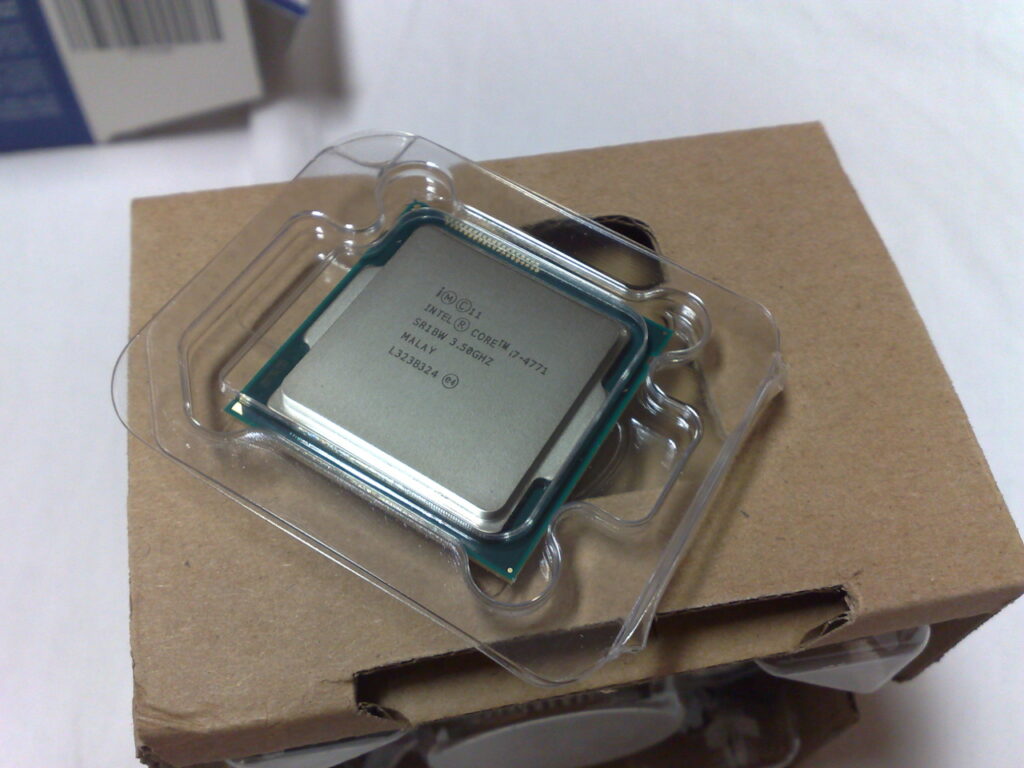
Intel Iris 5100 / Iris Pro 5200 (Haswell, 2013)
These were extended versions of Intel’s integrated graphics aimed at demanding users, featuring between 40 and up to 128 execution units (EUs), often paired with fast eDRAM memory known as Crystalwell. For example, the Iris Pro 5200 (based on Haswell architecture) achieved performance in the range of approximately 883 to 1728 GFLOPS, making it capable of handling more advanced 3D graphics and video editing tasks such as CAD modeling and rendering. These iGPUs were the first Intel integrated graphics solutions that could realistically compete with entry-level dedicated GPUs, providing a significant boost for professional and creative workloads.
Intel HD Graphics 5500/5600 (Broadwell, 2014)
The Broadwell generation brought further improvements to Intel’s integrated graphics, offering the HD Graphics 5500 and 5600 models with 24 and 32 execution units (EUs), respectively. Their performance reached approximately 365 GFLOPS for the 5500 and 403 GFLOPS for the 5600. These iGPUs supported DirectX 11.2 and OpenGL 4.3, as well as hardware acceleration for video decoding and encoding, including H.264 and HEVC formats. With enhanced Intel Quick Sync technology, Broadwell graphics delivered improved efficiency in multimedia tasks. The HD Graphics 5500 and 5600 were primarily used in ultrabooks and mid-range laptops, enabling smooth gameplay in popular esports titles at low to medium settings and providing comfortable multimedia performance.
Intel Iris 6100 / Iris Pro 6200 (Broadwell, 2014)
The Intel Iris Graphics 6100 is a high-performance integrated GPU featuring 48 execution units (EUs) and delivering around 844.8 GFLOPS of compute power. It marked a significant improvement over previous generations, offering better support for DirectX 11.2 and enhanced performance in gaming and multimedia applications.
The Iris Pro Graphics 6200, a GT3e variant with 128 execution units and integrated fast eDRAM (Crystalwell), boosts memory bandwidth and overall performance. This model achieved approximately 883.2 GFLOPS, enabling advanced 3D graphics, professional video editing, and demanding CAD workloads. It was Intel’s flagship iGPU of the generation, competing with lower-end dedicated graphics cards.
Intel HD Graphics 520/530 (Gen9, Skylake, 2015)
The HD Graphics 520 and 530 integrated GPUs, part of Intel’s 9th-generation Skylake architecture, represented a meaningful step forward in performance and multimedia capabilities.
HD Graphics 520 was mainly used in energy-efficient U-series mobile processors (e.g., Core i5-6200U). It featured 24 execution units (EUs) with clock speeds up to 1050 MHz, delivering around 403.2 GFLOPS of compute power. This made it suitable for everyday tasks like office work, web browsing, HD video playback, and light gaming in older or less demanding titles.
HD Graphics 530, found in higher-power desktop and H-series mobile CPUs (e.g., Core i7-6700K), also had 24 EUs but ran at higher clock speeds up to 1150 MHz, achieving roughly 441.6 GFLOPS. It supported smooth gameplay in esports titles and older AAA games such as CS:GO (~100 FPS), GTA V (~50 FPS), and The Witcher 3 (~20 FPS) on low settings at 720p or lower resolutions.
Both GPUs supported modern APIs and multimedia technologies, including DirectX 12.0, OpenGL 4.4, HEVC and VP9 hardware decoding, and HDCP 2.2 for 4K content. Intel Quick Sync Video was also enhanced for faster video encoding and decoding.
Intel Iris 540/550 / Iris Pro 580 (2015–2016, Skylake)
The Iris Graphics 540 is a GT3e integrated GPU featuring 48 execution units (EUs), a base clock around 1050 MHz, and delivering approximately 806.4 GFLOPS of performance. It provides solid performance for multimedia tasks, moderate gaming, and productivity applications, supporting DirectX 12 and OpenGL 4.4.
The Iris Graphics 550 improves on this with a higher clock speed (~1100 MHz) and about 844.8 GFLOPS, making it a more capable option for gaming and creative workflows within integrated graphics limitations.
The Iris Pro Graphics 580 is the top-tier GT4e model, with 72 execution units and integrated eDRAM cache (128 MB), running around 1000 MHz and offering roughly 1152 GFLOPS. This iGPU delivers enhanced bandwidth and significantly improved performance, suitable for demanding 3D graphics, video editing, and CAD tasks, often competing with entry-level dedicated GPUs.
Intel HD Graphics 620/630 (Kaby Lake, Gen9.5, 2016–2017)
Intel HD Graphics 620 and 630, both part of the Kaby Lake family (9.5th Gen architecture), delivered solid integrated graphics performance for mainstream laptops and desktops between 2016 and 2018.
HD Graphics 620, used in energy-efficient U-series mobile CPUs (like the Core i3-7100U, i5-7200U, i5-7300U, i7-7500U, and i7-7600U), came with 24 Execution Units (EUs) and clock speeds ranging from 1000 to 1050 MHz, reaching a peak compute performance of about 403.2 GFLOPS. It supported DirectX 12, OpenGL 4.5, OpenCL 2.1, and full hardware acceleration for 4K video playback, including HEVC 10-bit and VP9 decoding. While not designed for gaming, HD 620 could handle light esports titles like CS:GO, League of Legends, or Dota 2 at playable frame rates on low-to-medium settings.
HD Graphics 630, found in desktop CPUs such as the Pentium G4620, Core i3, i5, and i7 (7th Gen), as well as in H-series laptop processors, offered a similar architecture but sometimes included hardware L3 cache sharing and broader thermal limits. It also had 24 EUs, but with higher boost clocks (up to 1150 MHz), resulting in a maximum theoretical performance of about 441.6 GFLOPS. This iGPU could run a wider range of older or optimized 3D games and was commonly used for casual gaming and multimedia applications.
Both iGPUs supported Intel Quick Sync Video, 4K streaming, and HDCP 2.2, making them suitable for modern entertainment and productivity tasks. Despite being mid-tier integrated graphics, HD 620 and HD 630 remained among the most widely deployed Intel GPUs of their time due to their efficiency and reliability.
Intel Iris Plus Graphics 640/650 (Kaby Lake, 2017)
The Intel Iris Plus 640 and 650 are advanced integrated GPUs designed for select 7th generation (Kaby Lake) U-series processors. Built on the Gen9.5 GT3e architecture, these GPUs feature 48 execution units (EUs) and include 64 MB of eDRAM acting as an L4 cache, which significantly reduces latency and boosts graphics data throughput compared to standard UHD graphics.
Iris Plus 640 runs at a base clock of 300 MHz and boosts between 950 and 1050 MHz, delivering performance ranging from approximately 729.6 to 806.4 GFLOPS. It is found in processors such as the Core i5-7260U, i5-7360U, i7-7560U, and i7-7660U. Thanks to its higher EU count and eDRAM support, the 640 model offers smoother performance in creative applications, better gaming experiences, and efficient handling of 4K displays.
In real-world use, the Iris Plus 640 outperforms the UHD 620 by a noticeable margin — enabling playable frame rates in games like Overwatch, CS:GO, and Rocket League at medium settings in 720p or 1080p resolutions.
Iris Plus 650 is clocked even higher, with boost clocks from 1050 to 1150 MHz and peak performance reaching up to ~883.2 GFLOPS. It is integrated in higher-end processors such as the i3-7167U, i5-7267U, i5-7287U, and i7-7567U, targeting ultrabooks requiring stronger graphics power.
Its performance approaches that of entry-level dedicated mobile GPUs like the GeForce 920MX or GT 1030 DDR4, making it a solid choice for users involved in video editing, CAD work, light rendering, and indie gaming without needing a discrete graphics card.
Intel UHD Graphics 620/630 (Kaby Lake Refresh/Amber Lake/Coffee Lake/Coffee Lake Refresh/ Whiskey Lake/Comet Lake Core, Gen9.5 (2017–2020)
With the launch of Intel’s 8th to 10th Generation Core processors, integrated graphics continued to evolve under the UHD Graphics branding. These iGPUs were based on the Gen9.5 architecture and included support for modern APIs like DirectX 12.0 and OpenGL 4.5, along with full hardware decoding of HEVC, VP9, and HDCP 2.2 content. The UHD 620 and UHD 630 became the standard solutions for mobile and desktop platforms, respectively, delivering reliable performance for everyday tasks, 4K video playback, and light gaming.
UHD Graphics 620 was the most widespread iGPU in Intel’s 8th and 10th Gen U-series processors (15W TDP), including CPUs like the Core i5-8250U, i5-10210U, and i7-8565U. Equipped with 24 execution units (EUs) and clock speeds between 1000 and 1150 MHz, it reached up to ~441.6 GFLOPS of compute performance.
Despite being a low-power mobile GPU, it handled daily productivity tasks with ease, enabled smooth 4K media playback, and offered playable frame rates in popular games like CS:GO (~90–100 FPS), League of Legends, and Dota 2 at low or medium settings. For ultraportables and office laptops, the UHD 620 struck a great balance between efficiency and capability.
UHD Graphics 630 was designed for more powerful desktop and high-performance mobile processors across Intel’s 8th, 9th, and 10th Gen Core series, including chips like the i5-9600K, i7-9700, and i7-10700H. It also featured 24 EUs, but had a wider dynamic clock range — from 350 MHz base up to 1250 MHz boost — achieving up to 480 GFLOPS of compute power.
Intel UHD Graphics 600 (Gemini Lake, 2017)
Intel UHD Graphics 600 is an integrated GPU found in Gemini Lake processors such as the Pentium N4100. It features 12 execution units (EUs) clocked between 300 and 700 MHz (boost up to 750 MHz), supports DirectX 12_1 and OpenGL 4.4 APIs, and uses 14 nm technology. Designed for low-power systems, it shares memory with DDR4 or LPDDR4. While not a gaming powerhouse, it efficiently handles multimedia playback, hardware-accelerated video decoding via Quick Sync, and everyday tasks. Performance benchmarks place it modestly among entry-level iGPUs, suitable for basic graphical workloads and lightweight applications.
Intel Iris Plus Graphics 645 / 655 (Kaby Lake Refresh, 2018)
The Intel Iris Plus Graphics 645 and 655 represent enhanced versions of the Gen9.5 GT3e integrated GPUs, designed for select 8th generation Kaby Lake Refresh U-series processors. Both feature 48 execution units (EUs) and 128 MB of eDRAM — doubling the cache size compared to the earlier Iris Plus 640/650 models, which significantly improves bandwidth and reduces latency for graphics workloads.
Iris Plus 645 operates with a base clock around 300 MHz and boost frequencies ranging from 1050 to 1150 MHz, delivering peak compute performance between 806.4 and 883.2 GFLOPS. This GPU is integrated into processors such as the Core i7-8557U and i5-8257U, targeting ultraportable laptops requiring robust graphics performance for productivity and casual gaming.
Thanks to the larger eDRAM cache and higher clock speeds, the 645 offers noticeable gains over previous generations, enabling smooth video editing, CAD, and medium-level gaming at 1080p.
Iris Plus 655 pushes the performance further, with boost clocks from 1050 to 1200 MHz and peak compute throughput up to 921.6 GFLOPS. Found in higher-end processors like the i7-8559U, i5-8269U, i5-8259U, and i3-8109U, this GPU is ideal for users needing enhanced graphics capabilities without a discrete GPU.
The 655 model competes with entry-level dedicated GPUs, offering excellent performance in 3D rendering, video editing, and gaming titles on low to medium settings — making it a great fit for ultrabooks and compact laptops focused on a balance of portability and power.
Intel UHD Graphics and Iris Plus Graphics (Ice Lake, 2019)
Intel’s 11th generation integrated graphics, introduced with the 10 nm Ice Lake processors, marked a significant leap forward in iGPU design. The Gen11 microarchitecture brought several new features and enhancements aimed at boosting performance, efficiency, and multimedia capabilities.
Key innovations included:
- A 10 nm manufacturing process enabling better power efficiency.
- 10-bit HEVC encoding pipelines for improved video encoding quality.
- Support for multiple high-resolution displays: up to three 4K screens simultaneously, or configurations such as two 5K at 60 Hz or one 4K at 120 Hz.
- Variable Rate Shading (VRS), allowing better rendering efficiency by varying shading rates across a frame.
- Integer scaling for sharper pixel-perfect scaling of low-resolution content.
- While double-precision floating-point (FP64) was supported in desktop microarchitectures, mobile variants emulate this feature in software rather than native hardware support.
| Name | Tier | Execution Units (EUs) | Shading Units | Base Clock (MHz) | Boost Clock (MHz) | FP32 GFLOPS | Used in |
|---|---|---|---|---|---|---|---|
| UHD Graphics (G1) | G1 | 32 | 256 | 300 | 900–1050 | 921.6 – 1075.2 | Core i3-10xx G1, i5-10xx G1 |
| Iris Plus Graphics (G4) | G4 | 48 | 384 | 300 | 900–1050 | 1382.4 – 1612.8 | Core i3-10xx G4, i5-10xx G4 |
| Iris Plus Graphics (G7) | G7 | 64 | 512 | 300 | 1050–1100 | 2150.4 – 2252.8 | Core i5-10xx G7, i7-10xx G |
The UHD Graphics G1 represents the entry-level tier with 32 execution units and performance up to around 1075 GFLOPS FP32. It supports everyday multimedia tasks, smooth 4K playback, and light gaming.
The Iris Plus Graphics G4 offers a mid-tier solution with 48 execution units and up to 1612 GFLOPS, ideal for heavier multimedia workloads, video editing, and moderate gaming performance.
The top-tier Iris Plus Graphics G7 delivers 64 execution units and peak FP32 performance exceeding 2200 GFLOPS, competing with some budget discrete graphics cards. It suits demanding tasks such as 3D rendering, advanced video editing, and higher-end gaming on integrated graphics.
Intel UHD Graphics and Iris Xe Graphics (Tiger Lake/Alder Lake/Raptor Lake, 2020-2022)
The Xe-LP (Low Power) architecture is the first generation of Intel’s modern integrated graphics from the Xe family, introduced with Rocket Lake processors (Intel 11th and 12th Gen) and continued in Alder Lake, Raptor Lake, and newer generations. Xe-LP represents a significant advancement over previous generations, offering much higher performance, modern features, and better power efficiency.
Xe-LP GPUs are manufactured using Intel’s 14++ nm and newer 7 nm process (also referred to as 10ESF) and come equipped with between 16 and 96 Execution Units (EUs), allowing for a wide scalability of graphics power.
| Model | Process Tech | EU | Shading Units | Max Boost (MHz) | FP32 Performance (GFLOPS) | Notes |
|---|---|---|---|---|---|---|
| Intel UHD Graphics 710 | Intel 7 (10ESF) | 16 | 128 | 1300–1350 | 333–346 | Alder Lake-S/HX, Raptor Lake-S/HX |
| Intel UHD Graphics 730 | Intel 14++ nm / 7 | 24 | 192 | 1200–1450 | 538–557 / 922–1114 | Rocket Lake, Alder Lake |
| Intel UHD Graphics 750 | Intel 14++ nm | 32 | 256 | 1200–1300 | 614–666 | Rocket Lake-S |
| Intel UHD Graphics 770 | Intel 7 | 32 | 256 | 1450–1550 | 742–794 | Alder Lake, Raptor Lake |
| Intel UHD Graphics P750 | Intel 14++ nm | 32 | 256 | 1300 | 666 | Xeon W-1300 series |
| Intel UHD Graphics 11th Gen | Intel 10SF | 32 | 256 | 1400–1450 | 717–742 | Tiger Lake-H |
| Intel UHD Graphics 11th Gen G4 | Intel 10SF | 48 | 384 | 1100–1250 | 845–960 | Tiger Lake-U |
| Iris Xe Graphics G7 (80 EU) | Intel 10SF | 80 | 640 | 1100–1300 | 1408–1664 | High performance |
| Iris Xe Graphics G7 (96 EU) | Intel 10SF | 96 | 768 | 1050–1450 | 1690–2227 | Top-tier laptop variant |
| Intel UHD Graphics for 12th & 13th Gen | Intel 7 | 48-64 | 384-512 | 700–1400 | 538–1434 | Alder Lake, Raptor Lake |
| Iris Xe Graphics for 12th & 13th Gen | Intel 7 | 80-96 | 640-768 | 900–1450 | 1152–2227 | High performance in new laptops |
The Xe-LP architecture brought a significant boost in power and flexibility to Intel’s integrated graphics. Models from UHD Graphics 710, 730, and 750 to advanced Iris Xe with 80 or 96 Execution Units support modern multimedia technologies, 4K resolution, DirectX 12 Ultimate, as well as improved AI and 3D graphics support.
Intel Arc Alchemist (Meteor Lake/Arrow Lake)
Intel’s Arc Alchemist GPUs are based on the Gen12.7 microarchitecture and are featured in the upcoming Meteor Lake and Arrow Lake platforms. These GPUs bring significant improvements in graphics performance and modern multimedia capabilities.
New Features:
- Support for DirectX 12 Ultimate Feature Level 12_2
- Native HDMI 2.1 with 48 Gbps bandwidth
- 8K 10-bit AV1 hardware encoding support
| Model | Execution Units (EU) | Shading Units | Max Boost Clock (MHz) | FP32 Performance (GFLOPS) |
|---|---|---|---|---|
| Arc Graphics 48EU Mobile | 48 | 384 | 1800 | 1382 |
| Arc Graphics 64EU Mobile | 64 | 512 | 1750–2000 | 1792 |
| Arc Graphics 112EU Mobile | 112 | 896 | 2200 | 3942 |
| Arc Graphics 128EU Mobile | 128 | 1024 | 2200–2350 | 4608 |
Gaming Performance
The table below presents an approximate number of frames per second (FPS) achieved in selected popular PC games by three generations of Intel integrated graphics: HD Graphics 4600, Intel UHD Graphics 630, and Intel Iris Xe (96 EU).
To ensure reliability and comparability, all results were collected using low or medium graphics settings at HD (1366×768) or Full HD (1920×1080) resolution — typical conditions for laptops and systems with integrated GPUs.
The data for HD 4600 and UHD 630 comes from industry benchmarks published by sites such as TechCenturion and G2A.com. For Iris Xe 96 EU, data from user benchmarks and community reports were also included.
To better illustrate the performance gap, the comparison includes a dedicated yet somewhat older mid-low-end graphics card — the GeForce GTX 1650. While no longer cutting-edge or high-end, it clearly outperforms even the latest integrated Intel GPUs — including the new Arc iGPU from the Meteor Lake series. This highlights that even an older, budget discrete GPU still delivers noticeably better performance than modern integrated graphics.
This cross-generational comparison helps illustrate how Intel’s integrated graphics have evolved over the years, and which generation performs best in popular games like CS:GO, GTA V, or Fortnite — without requiring a dedicated graphics card.
Naturally, real-world FPS may vary depending on system configuration (CPU, RAM, drivers, operating system).
Important Note:
Integrated graphics do not have dedicated VRAM and rely on system memory. Therefore, iGPU performance heavily depends on:
- Memory type (DDR3, DDR4, LPDDR4/5)
- Memory frequency (in MHz)
- Memory bus width (in bits)
Older iGPUs using DDR3 1333–1600 MHz were heavily bottlenecked — explaining the low FPS seen with HD 3000 or HD 4000.
Newer iGPUs using LPDDR4x 3733–4266 MHz (Ice Lake, Tiger Lake) benefit from faster memory, significantly improving performance.
Additionally, different CPU versions may run at lower clock speeds depending on power-saving settings, thermal limitations, or platform-specific restrictions — which can also affect FPS.
| GPU (Generation) | CS:GO 1366×768, low | GTA V 1366×768, low | Witcher 3 1280×720, low | Fortnite 1920×1080, medium | Valorant 1920×1080, low | Minecraft 1920×1080, default | Skyrim 1280×720, low |
| GMA X4500 (Core 2 Duo) | ❌ <10 FPS | ❌ <5 FPS | ❌ | ❌ | ❌ | ~20 FPS | ~10 FPS |
| HD Graphics (Ironlake) 1. Gen (Clarkdale, Arrandale) | ~15 FPS | ❌ <10 FPS | ❌ | ❌ | ~25 FPS | ~30 FPS | ~15 FPS |
| HD Graphics 3000 Sandy Bridge (2011) | ~30 FPS | ~20 FPS | ~10 FPS | ❌ | ~35 FPS | ~50 FPS | ~25 FPS |
| HD Graphics 4000 Ivy Bridge (2012) | ~40 FPS | ~25 FPS | ~15 FPS | ~15 FPS | ~45 FPS | ~60 FPS | ~30 FPS |
| HD Graphics 4600 Haswell (2013) | ~60 FPS | ~25 FPS | ~16 FPS | ~30 FPS | ~70 FPS | ~70 FPS | ~40 FPS |
| HD Graphics 530 Skylake (2015) | ~70 FPS | ~35 FPS | ~18 FPS | ~35 FPS | ~80 FPS | ~80 FPS | ~50 FPS |
| UHD Graphics 620 Kaby Lake-R (2017) | ~85 FPS | ~40 FPS | ~20 FPS | ~38 FPS | ~90 FPS | ~90 FPS | ~55 FPS |
| UHD Graphics 630 Coffee Lake (2017–2019) | >100 FPS | ~50 FPS | ~20 FPS | ~40 FPS | ~100 FPS | ~100 FPS | ~60 FPS |
| Iris Plus G7 (Ice Lake) 64 EU (2019) | ~120 FPS | ~55 FPS | ~25 FPS | ~50 FPS | ~120 FPS | ~110 FPS | ~65 FPS |
| Iris Xe (Tiger Lake) 96 EU (2020) | ~150 FPS | ~60 FPS | ~30 FPS | ~60 FPS | ~140 FPS | ~130 FPS | ~75 FPS |
| Arc iGPU (Meteor Lake) 128 EU Xe-LPG (2024) | ~180 FPS | ~70 FPS | ~40 FPS | ~75 FPS | ~160 FPS | ~150 FPS | ~85 FPS |
| NVIDIA GeForce GTX 1650 | ~250 FPS | ~120 FPS | ~55 FPS | ~110 FPS | ~240 FPS | ~220 FPS | ~180 FPS |
Theoretical Performance of Intel Graphics Iris Xe vs UHD
Over the years, Intel’s integrated graphics cards have undergone a dramatic evolution. Each new generation has brought a noticeable performance boost — often nearly doubling the capabilities of its predecessor. For example, Intel HD Graphics 4600 (2013) enabled smooth gameplay in less demanding esports titles such as CS:GO or Valorant, though it struggled with newer, more resource-intensive games.
The launch of Intel UHD Graphics 630 (2017) marked a clear step forward — this GPU was capable of delivering around 50 FPS in older yet still popular games like GTA V, Skyrim, or Counter-Strike: Global Offensive.
A true breakthrough in Intel’s integrated graphics came with the introduction of Iris Xe and, later, the Arc-based iGPUs. In the context of Intel Iris Xe vs UHD, the performance jump is substantial — with compute power now exceeding 4 TFLOPS, these GPUs enable smooth 1080p gaming in popular titles like Fortnite or Battlefield 1, even on medium settings.
The chart below shows the cumulative performance growth of Intel integrated graphics, using the GMA X4500 (from the Core 2 Duo era) as the baseline with a value of 1.0 point. Each subsequent generation indicates how much more powerful the newer iGPUs are compared to this reference point.
These results demonstrate how, over the years, Intel has gradually but consistently improved its integrated graphics – both in terms of raw computing power (TFLOPS) and practical performance in games and multimedia.
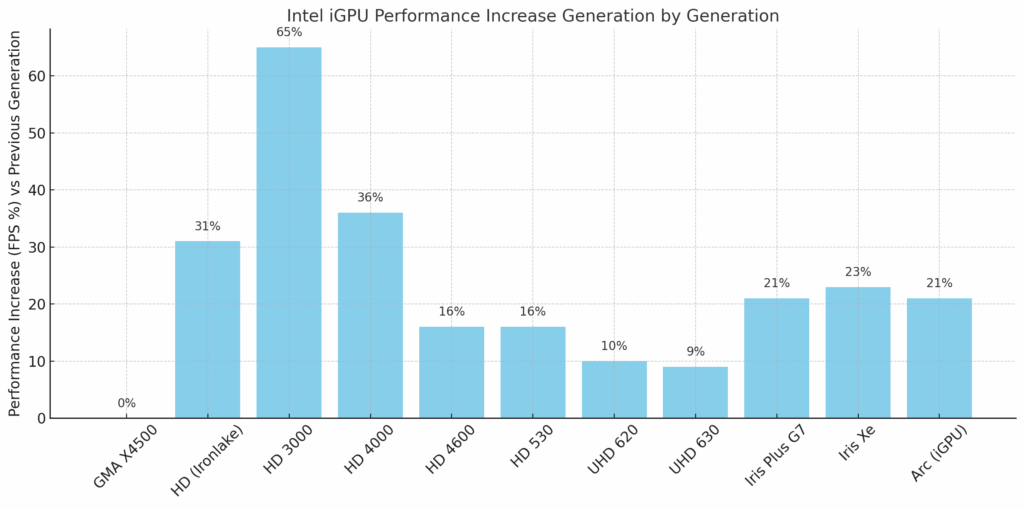
The chart above illustrates how the performance of Intel’s integrated GPUs has evolved across successive processor generations — not in comparison to the oldest GPU, but relative to the previous model. This allows us to trace which generations brought significant real-world improvements, and which delivered only minor upgrades.
The GMA X4500 (from the Core 2 Duo era) serves as the starting point — its performance is considered a 0% increase.
HD Graphics (Ironlake) from the 1st generation Intel Core (Clarkdale/Arrandale) already delivered a 31% performance boost — a modest but noticeable step forward.
Sandy Bridge (HD Graphics 3000) marked a true breakthrough. With a 65% improvement over Ironlake, it made basic gaming realistically achievable.
Ivy Bridge (HD Graphics 4000) and Haswell (HD 4600) continued the upward trend, offering around 36% and 16% gains, respectively.
From Skylake (HD 530) to Kaby Lake-R (UHD 620), the pace of improvement slowed somewhat — with more moderate gains of 10–15%.
Another major leap came with Ice Lake (Iris Plus G7) and Tiger Lake (Iris Xe), bringing +21% and +23% increases respectively. This was largely due to the transition to Gen11/Gen12 architecture, more execution units (EUs), and support for modern APIs such as DirectX 12.
The Arc iGPU (Meteor Lake, Xe-LPG) marks the biggest generational jump in Intel iGPU history: +21% over Iris Xe and approximately 8.5× better performance compared to the GMA X4500. This is the first Intel integrated GPU that truly starts to encroach on the entry-level dedicated GPU segment.
Multimedia and AI
Intel’s integrated graphics have evolved not only in terms of raw computing power but also in their multimedia and artificial intelligence (AI) capabilities. For over a decade, Intel has systematically expanded its graphical and multimedia functions, making its iGPUs increasingly versatile — suitable not just for gaming, but also for professional applications.
Intel Quick Sync and Next-Generation Video Codecs
A major breakthrough came with the introduction of Intel Quick Sync Video in Sandy Bridge processors (2011). This enabled fast, hardware-accelerated video encoding in the H.264 format, greatly improving workflows such as video editing, streaming, and file conversion.
Subsequent iGPU generations added support for newer codecs — including HEVC (H.265) and VP9 (introduced with Kaby Lake). Starting with the Tiger Lake architecture, Intel integrated graphics now fully support AV1 video decoding (both 8-bit and 10-bit). As a result, processors equipped with Iris Xe graphics can smoothly play even demanding 4K HDR streams, while maintaining very low power consumption — often below 15 watts.
AI Support: NPU and Intel XeSS
In parallel, Intel has also been advancing its AI-related technologies. The Xe architecture introduced XMX units (Xe Matrix Extensions) — matrix accelerators for AI workloads, functionally similar to NVIDIA’s Tensor Cores. With the launch of Intel Core Ultra processors, dedicated NPUs (Neural Processing Units) have been added to handle on-device AI inference tasks — used in applications like AI upscaling, image recognition, and even video conferencing features such as background blur.
Also worth noting is Intel XeSS (Xe Super Sampling) — an AI-based counterpart to NVIDIA’s DLSS. It allows for resolution upscaling in games without heavily taxing the GPU, significantly improving both frame rates and visual quality.
Summary: From Basic Intel Graphics to Advanced Rendering Engines
From the early days of Intel HD Graphics (2010) offering just 12–43 GFLOPS, through more capable models like HD 4600 and UHD 630 (over 500 GFLOPS), to the latest Iris Xe and Arc iGPUs (up to 4.6 TFLOPS), Intel’s integrated graphics have undergone a dramatic transformation.
Today, they are not only capable of running games at 1080p, but also offer comprehensive support for 4K multimedia, modern video codecs, and AI-driven applications. Intel Graphics has become a fully-featured graphics platform for home users, gamers, content creators, and professionals alike.
How to Download the Latest Intel Graphics Driver
To ensure the best performance and compatibility for your integrated GPU, it’s important to keep your drivers up to date. You can download the latest Intel graphics driver directly from the official Intel Download Center, where drivers for Intel HD Graphics and newer generations are regularly updated.

0 Comments