What you will understand
- A cash forecast needs opening cash and payment timing, not just revenue.
- The example adds EUR 4,000 per month only while its explicit assumptions hold.
- An ending balance can hide an earlier reserve breach.
Start with a decision, not a spreadsheet format
A monthly cash flow forecast is a structured answer to a practical question: how might the money available to the business change if these assumptions hold? Before building one, choose the decision you need to examine. It might be whether an increase in operating costs is sustainable, how much a quieter sales period would consume, or whether slower collections put a reserve at risk.
The useful output is a sequence of cash balances with visible assumptions. A single annual profit number cannot show which month is tight. Equally, an attractive chart does not become a dependable forecast simply because it contains twelve points. Its value depends on the starting balance, the inputs and the treatment of cash timing.
The minimum inputs for a focused operating cash model
For this example, opening cash is EUR 10,000. Monthly revenue is EUR 20,000 and monthly operating cost is EUR 16,000. Both remain constant for six months. Revenue is collected in the month it is earned, costs are paid in that month, and there are no other cash movements. A reserve floor of EUR 5,000 is a comparison threshold, not an expense.
These deliberately narrow assumptions make the calculation auditable. If the business has taxes, loan repayments, capital purchases or other movements, those must be included in a broader review. Techbool currently models monthly operating revenue, cost and collection timing; it does not automatically supply the omitted schedules.
Choose opening cash from the balance relevant to the model and its start date. Do not substitute revenue or cumulative profit for it. When only part of the business is being modelled, label that scope so readers do not confuse a segment scenario with the cash position of the whole company.
| Input | Value |
|---|---|
| Opening cash | EUR 10,000 |
| Monthly revenue | EUR 20,000 |
| Monthly operating cost | EUR 16,000 |
| Collection delay | 0 months |
| Revenue and cost growth | 0% per month |
| Reserve floor | EUR 5,000 |
Calculate one month, then carry its balance forward
The cash identity is closing cash = opening cash + cash received - cash paid. In month one that is EUR 10,000 + EUR 20,000 - EUR 16,000 = EUR 14,000. Month two opens with EUR 14,000, so its closing cash becomes EUR 18,000. Carrying the balance forward avoids treating each month as an independent calculation.
With these constant inputs, monthly operating cash adds EUR 4,000. Six additions produce closing cash of EUR 34,000. This does not mean the business will have that balance: it is the consequence of the stated assumptions. The first reconciliation question is whether actual receipts and payments follow those assumptions.
| Month | Cash received | Cash paid | Closing cash |
|---|---|---|---|
| 1 | 20,000 | 16,000 | 14,000 |
| 2 | 20,000 | 16,000 | 18,000 |
| 3 | 20,000 | 16,000 | 22,000 |
| 4 | 20,000 | 16,000 | 26,000 |
| 5 | 20,000 | 16,000 | 30,000 |
| 6 | 20,000 | 16,000 | 34,000 |
Import CSV history as a baseline, not as a complete forecast
The downloadable CSV contains six illustrative months in three columns: month, revenue and cost. In Techbool, imported history establishes a baseline using the latest available period averages, up to three consecutive months. Because this sample is constant, its imported baseline is exactly EUR 20,000 and EUR 16,000.
Opening cash is entered separately. The import does not infer a bank balance, receivables, future seasonality or unpaid invoices. Check the displayed baseline and decide whether it is representative. An average that includes an unusual contract or a seasonal peak can be a poor starting point for the next period.
Keep history separate from the saved projection. The history says what was supplied; the scenario says what is assumed next. Reusing the same figures without labels is a common way for a planning estimate to be mistaken for an actual result.
month,revenue,cost
2026-01,20000,16000
2026-02,20000,16000
2026-03,20000,16000
2026-04,20000,16000
2026-05,20000,16000
2026-06,20000,16000
Compare the baseline with a specific downside
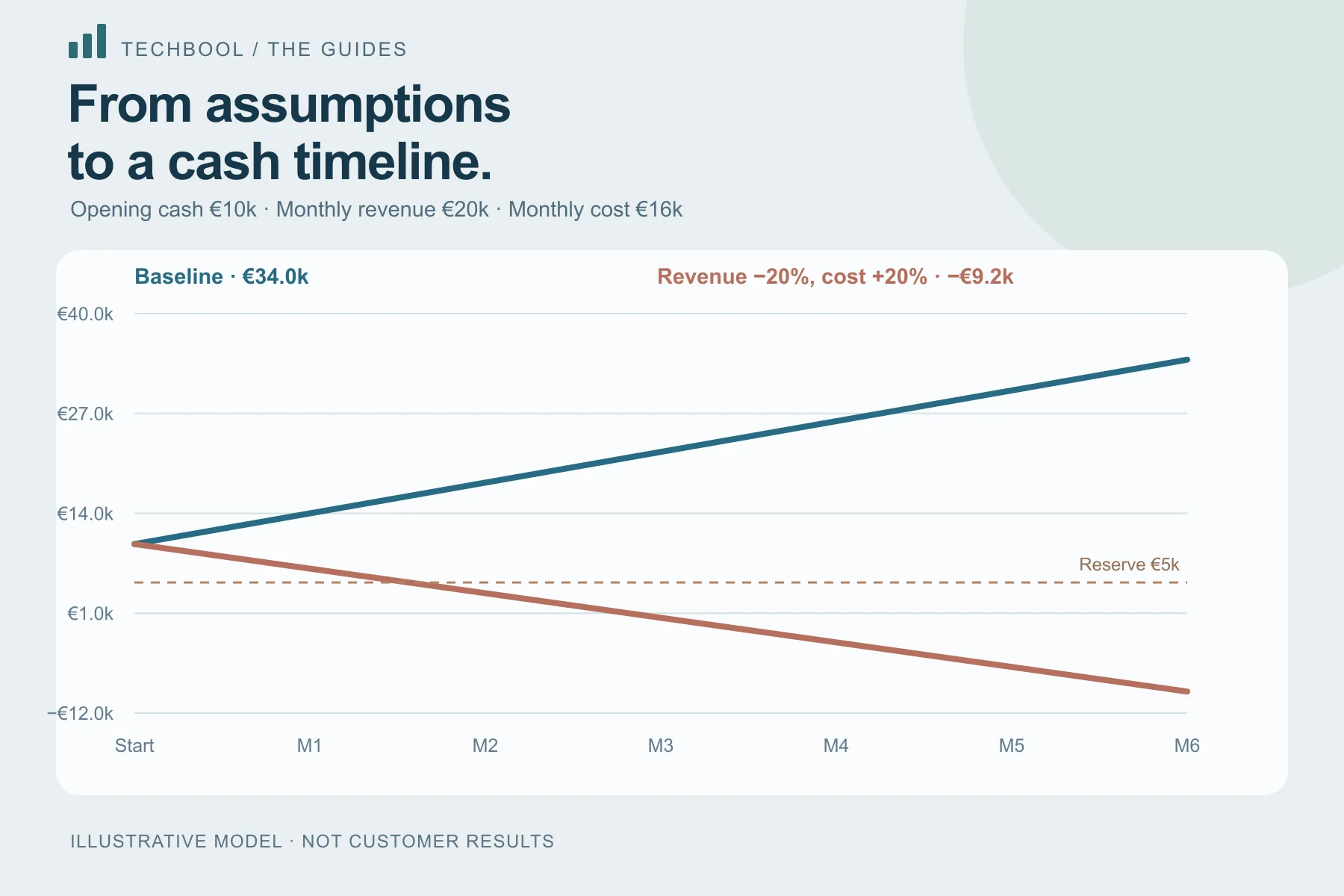
Reduce revenue by 20% and increase costs by 20%, keeping growth and delay at zero. Revenue becomes EUR 16,000 and costs become EUR 19,200. The monthly cash movement is minus EUR 3,200. Closing balances become EUR 6,800, EUR 3,600, EUR 400, minus EUR 2,800, minus EUR 6,000 and minus EUR 9,200.
The reserve is first breached in month two, even though cash does not become negative until month four. Those are different signals. A reserve is a chosen operating buffer; a negative projected balance indicates the model needs a cash source or a change in assumptions to continue as written. Neither signal alone explains which action is commercially feasible.
Compare matching months and the same model scope. Review the first reserve breach, the lowest balance and the ending balance together. Looking only at the final number can hide a temporary funding gap earlier in the horizon.
What to review before relying on the result
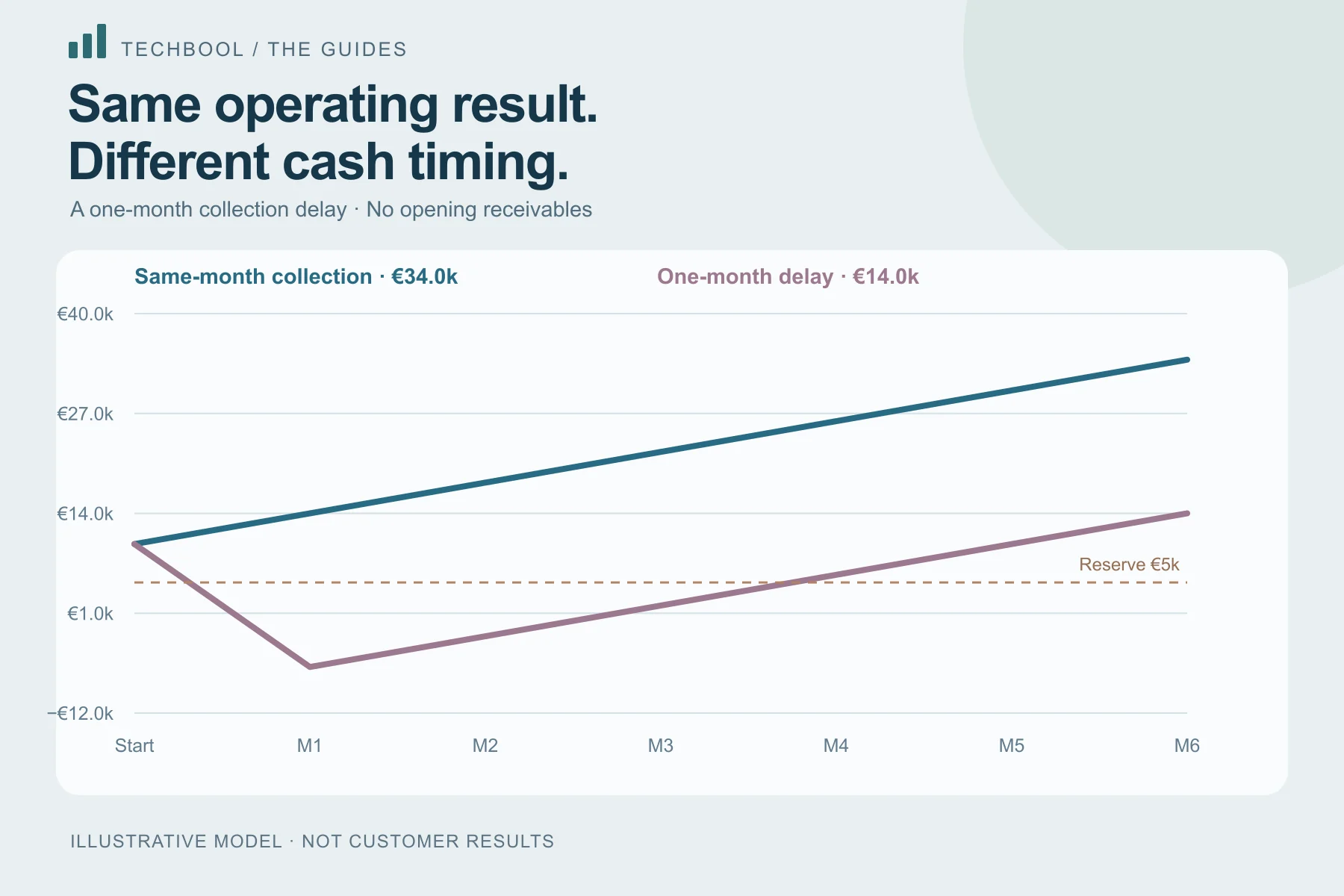
Check timing first. A one-month collection delay changes this example materially even when revenue and costs stay unchanged. Then check whether operating costs include all recurring payments relevant to the decision. Do not assume an operating cash model includes taxes, financing and capital spending unless the appropriate schedules are present.
Record what would make the scenario obsolete. A lost customer, a new commitment or changed payment terms can matter more than a small chart adjustment. Save a new scenario when assumptions change, rather than silently replacing the old decision record.
- Reconcile the opening balance to its date and scope.
- Distinguish earned revenue from collected cash.
- Document one-off items and excluded cash movements.
- Keep assumptions visible when exporting.
- Use current evidence and professional review for consequential financing decisions.
Run the example in Techbool
The six-month baseline fits Free. Import the sample CSV or enter the two baseline figures manually, set opening cash to EUR 10,000 and reserve to EUR 5,000, and leave growth and delay at zero. Save that result before creating the downside. You can compare saved scenarios and export their inputs and monthly calculations.
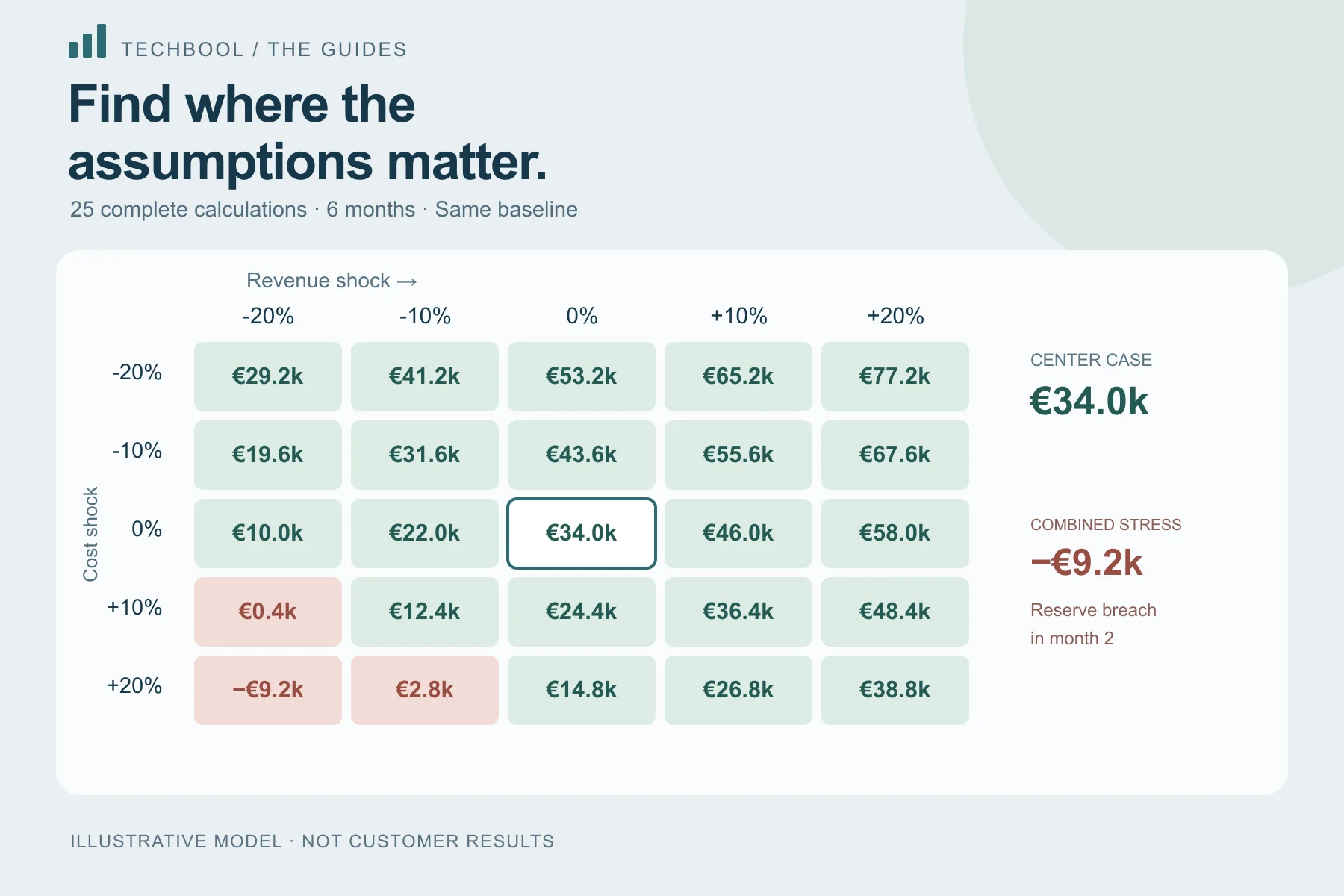
When the question expands to many revenue/cost combinations, use the sensitivity guide. When variation around a fixed set of assumptions is the question, the simulation guide explains what its percentile bands mean and what they cannot establish.
Keep the inputs.
Understand the outcome.
Start with a Free workspace. Inspect the calculation and compare a second scenario before choosing a paid analysis tool.