What you will understand
- Earned revenue and collected cash are different events.
- Opening receivables can materially change the early months.
- A simplified delay scenario is not a complete accounting forecast.
A positive operating result does not settle the cash question
A business can recognize revenue before receiving the money. It may also pay operating costs before the corresponding customer receipts arrive. That is why a positive profit figure does not, by itself, establish the amount available in the bank or whether a particular payment can be made.
Keep three concepts separate: revenue earned, cash received and cash paid. The simplified operating result in this guide is revenue minus operating cost. It is not complete accounting net profit because taxes, financing and other entries are outside the example.
Change collection timing while keeping the business inputs fixed
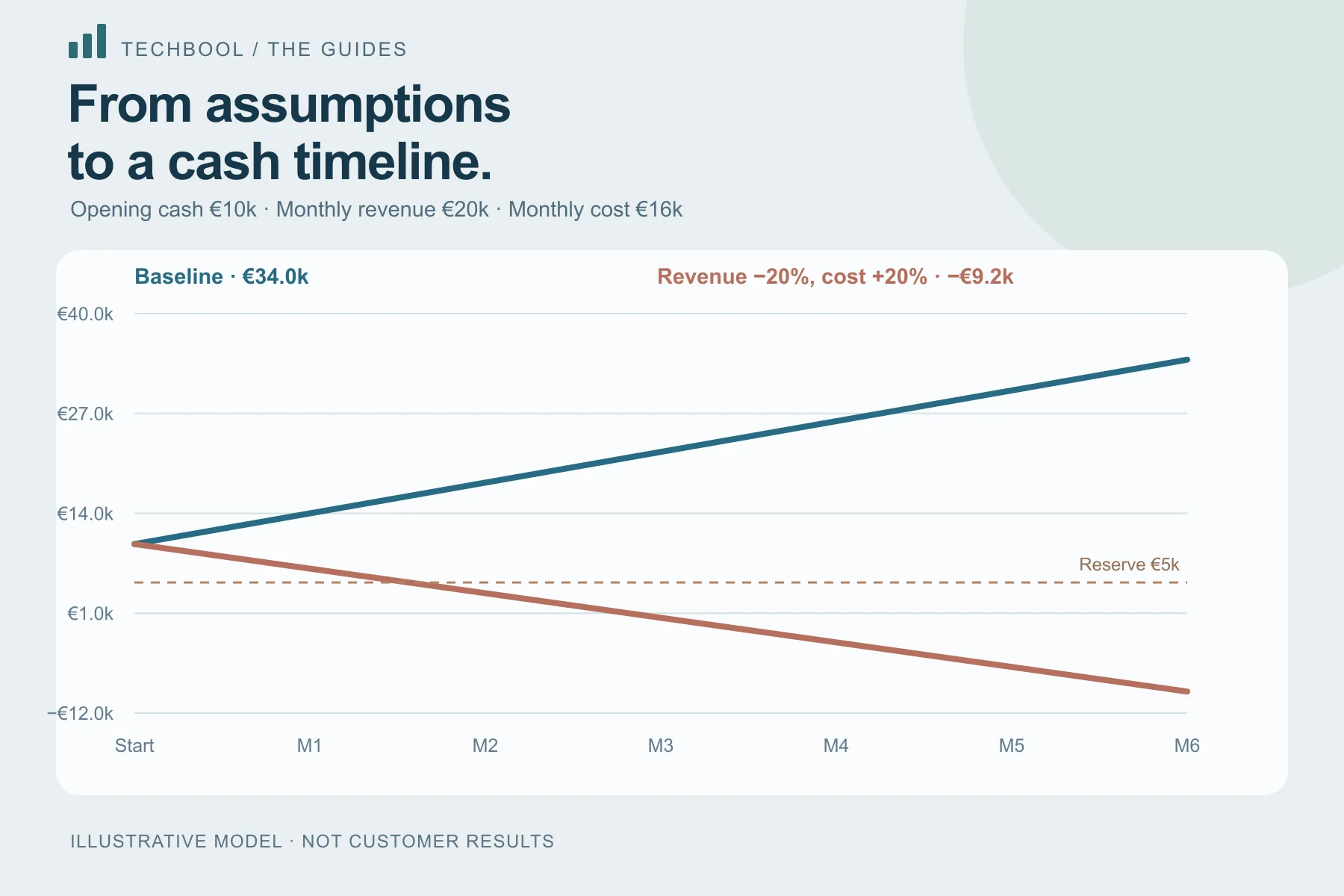
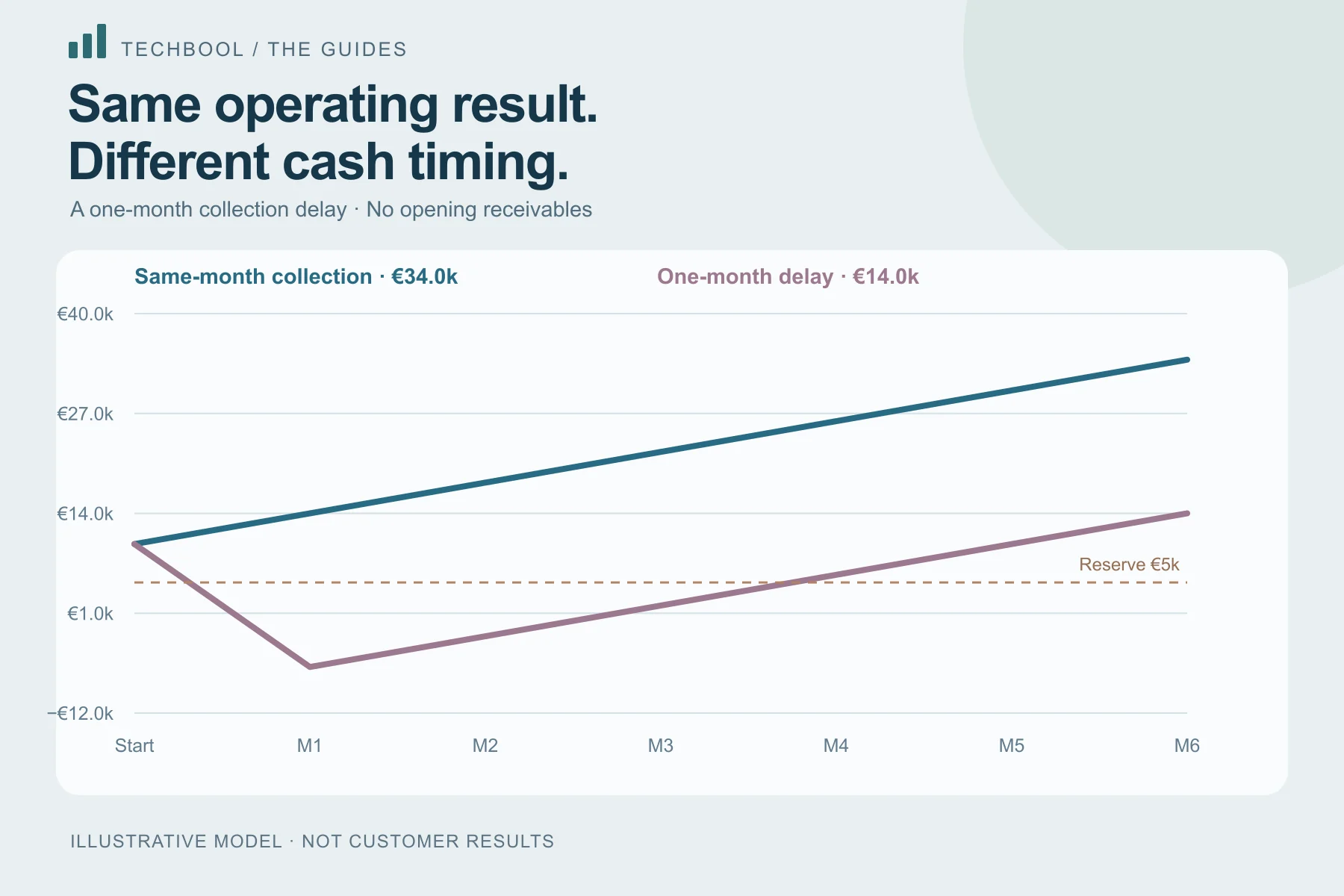
Opening cash is EUR 10,000, monthly revenue is EUR 20,000 and monthly operating cost is EUR 16,000. Neither figure grows. In the immediate-collection case, each month receives its own revenue, adding EUR 4,000 cash and ending month six at EUR 34,000.
Now move collection by one month. In month one, the model earns EUR 20,000 but receives none of it yet. It still pays EUR 16,000, so cash falls to minus EUR 6,000. In month two it collects the first month's EUR 20,000 and pays another EUR 16,000, ending at minus EUR 2,000.
From month two onward the constant example adds EUR 4,000 each month, but the initial missing receipt remains visible throughout the horizon. Month six ends at EUR 14,000, with one period of revenue still uncollected within the model.
| Month | Revenue earned | Cash received | Cash paid | Closing cash |
|---|---|---|---|---|
| 1 | 20,000 | 0 | 16,000 | -6,000 |
| 2 | 20,000 | 20,000 | 16,000 | -2,000 |
| 3 | 20,000 | 20,000 | 16,000 | 2,000 |
| 4 | 20,000 | 20,000 | 16,000 | 6,000 |
| 5 | 20,000 | 20,000 | 16,000 | 10,000 |
| 6 | 20,000 | 20,000 | 16,000 | 14,000 |
What was already owed at the start?
The example assumes no opening receivables. A real operating business may have invoices from before month one that will be collected during it. Those receipts can substantially change the early cash position. Omitting them and describing the resulting gap as a precise prediction would be misleading.
Techbool's current collection-delay control shifts projected revenue and does not import an opening receivables schedule. Use it as a clearly labelled timing stress. For an operational forecast that depends on outstanding invoices, use a model that explicitly contains them and their expected collection dates.
A negative projected balance does not mean an actual bank account has already gone negative. It says the scenario, as written, requires additional cash or a different pattern of receipts and payments. Reconcile that signal with bank balances, outstanding invoices, commitments and financing arrangements before acting.
A monthly delay is not the same as thirty days
A monthly model groups activity into periods. Moving revenue by one month does not reproduce every invoice date, weekend or customer payment term. Payments separated by a few days can cross a month boundary; payments almost a month apart can fall within the same calendar month.
Monthly scenarios are useful for a broad operating question, but less suitable for deciding whether a payment due next Tuesday is covered. Use a more granular cash schedule when the exact day matters. Relabelling a monthly chart does not add daily precision.
Read a reserve threshold as well as the zero line
The chosen reserve is EUR 5,000. The delayed scenario falls below it in the first projected month, remains below through month three and recovers above it in month four. Ending cash of EUR 14,000 does not erase the earlier gap.
Treat the reserve as an explicit assumption. It is not automatically a legal minimum, a bank requirement or a universal safety level. Different commitments and business models need different reviews. The chart should show what was tested rather than imply that any selected threshold is objectively sufficient.
Questions to ask when profit and cash diverge
Begin with timing and scope. Are the revenue numbers earned sales or bank receipts? Are costs accounting expenses or cash payments? Was opening cash taken before or after an important payment? These distinctions often explain more than adjusting a growth assumption.
Then identify cash movements outside the operating model. Taxes, loans, capital purchases, owner distributions and transfers can affect cash without appearing as ordinary monthly operating costs in the same way. A complete financial model needs the appropriate schedules, not an unexplained adjustment to revenue.
- Reconcile cash to a specific opening date.
- List opening receivables and payables separately.
- Distinguish expected collections from contractual due dates.
- Check whether the decision needs weekly or daily detail.
- Document taxes, financing and other excluded cash movements.
Compare two timing scenarios without changing the story
In Techbool, save an immediate-collection baseline and create a second scenario with a one-month delay. Keep the other assumptions unchanged. Compare matching months and label the delayed case as excluding opening receivables. Export the full input record when sharing the result.
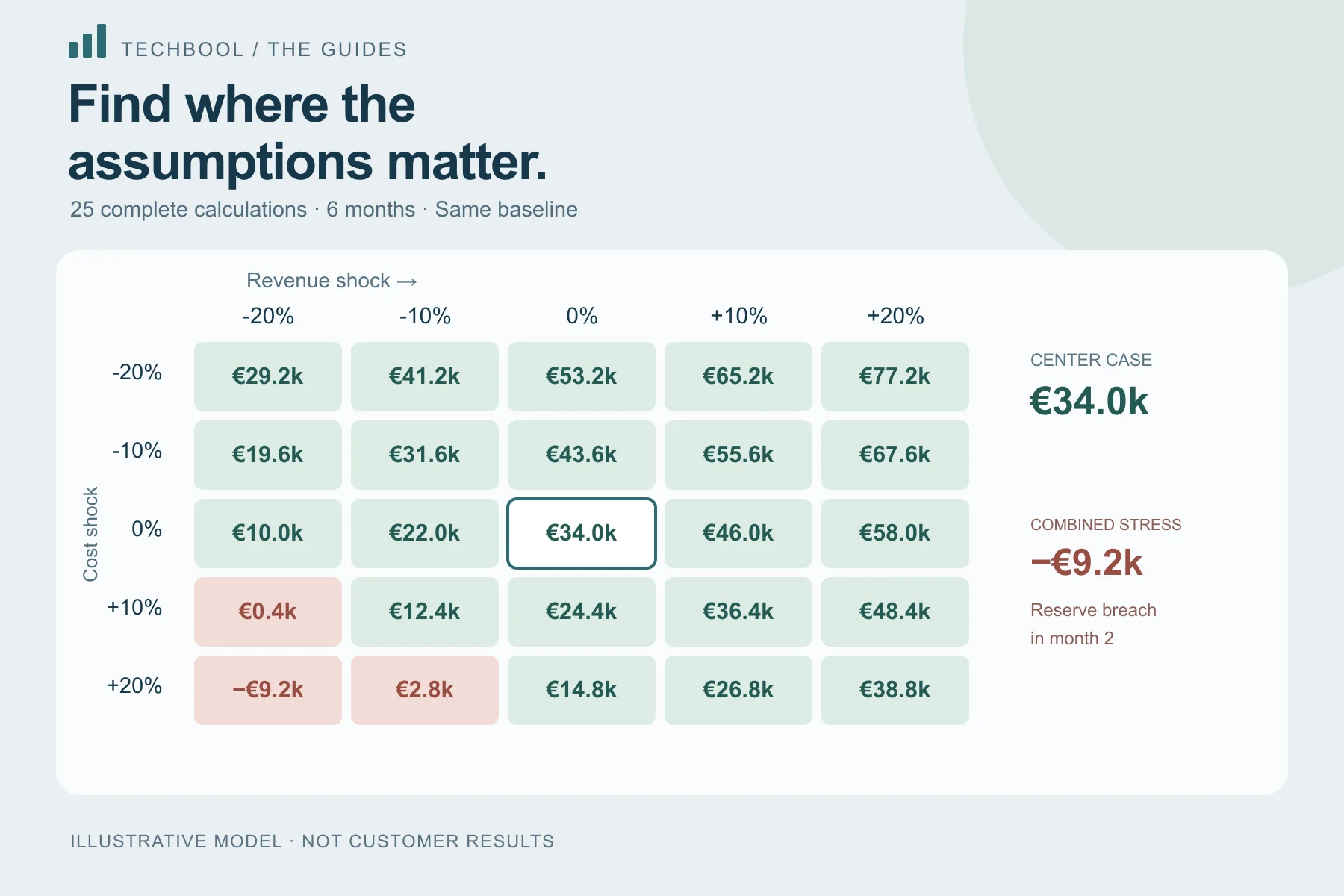
This exercise fits the six-month Free horizon. It explains a mechanism; it does not certify solvency or replace an accountant's cash-flow statement. Once timing is clear, test revenue and cost exposure separately so each comparison answers a specific question.
Keep the inputs.
Understand the outcome.
Start with a Free workspace. Inspect the calculation and compare a second scenario before choosing a paid analysis tool.